Residential Life Handbook
RESIDENTIAL LIFE 2026-2027 POLICY HANDBOOK
Download Print-Friendly Handbook (PDF)
IMPORTANT PHONE NUMBERS
- Residential Life Office: 620-276-9516
- Resident Assistant Duty Phone (after 5:00pm): 620-805-4999
- Admissions: 620-276-9608
- Advising: 620-275-3220
- Broncbuster Bookstore: 620-276-9790
- Business Office: 620-276-9619
- Cafeteria: 620-276-9607
- Campus Nurse: 620-276-9601
- Campus Police: 620-272-6828 or 620-276-9536
- Counselors: 620-276-9640
- Cosmetology: 620-276-0410
- Dean of Academics: 620-276-0441
- Dean of Student Services: 620-276-9508
- Dean of Technical Education: 620-276-9521
- Disabilities Services & Accommodations: 620-276-9638
- Student Activities: 620-276-0474
- Financial Aid: 620-276-9519
- Registrar: 620-276-9571
- Student Support Services: 620-275-3268
Building Secretaries
- Academic: 620-276-9580
- Dennis Perryman Athletic Complex: 620-276-9606
- Fouse Science & Math: 620-276-9550
- Penka: 620-276-9560
- Pauline Joyce Fine Arts: 620-276-9540
- Student & Community Services Center: 620-276-9519
- Thomas Saffell Library: 620-276-9511
MAINTENANCE ISSUES:
EMERGENCY (toilet overflowing, door lock, AC or heat, etc.): Call 620-805-4999
NON-EMERGENCY (light out, clogged drain, etc.): Call 620-276-9516 (leave a message)
TABLE OF CONTENTS
- Facilities and Services
- Adult Status
- Alcohol and Drug Policy
- Bystander Engagement
- Campus Crime Disclosure Act
- Campus Police
- Cleaning Equipment and Supplies
- Counseling Services
- Criminal History
- Disciplinary Action
- Disciplinary Fines and Points
- Emergencies
- Exterminator
- Electrical Appliance
- FERPA
- Furniture
- ADA Facilities
- Housing Operational Hours
- Identification Card (GCCC ID)
- Internet Use Policy
- Laundry Facilities
- Mail Service
- Maintenance
- Parking and Parking Permits
- Porches and Balconies
- Power Failures
- Professional Cleaning Services
- Residence Halls
- Residency Eligibility
- Shipping Service
- Student Right-to-Know/Campus Security Act
- Traffic Laws and Rules
- Trash (Trash Bags and Toilet Paper)
- Student Health Services
- Food Service
- Contract Information and Responsibilities
- Abandoned Items
- Cancellation or Termination of Contract
- Cancellation Charge Appeal Procedure
- Checking into Residence Halls
- Checking out of Residence Halls
- Damages
- Damages To or Loss of Personal Property
- Keys
- Keys and Vacations
- Room Assignments and Roommate Changes
- Storage
- Unapproved Room Change
- Vacancies
- Payments
- Policies and Procedures
- Aircraft Systems
- Alcohol, Drugs, and Drug Paraphernalia
- Ammunition
- Anti-Harassment Statement
- Attire
- Bicycles and Scooters
- Book Bags and Books
- Campus Fire Safety Report
- Candles
- Cleanliness Inspections
- Coercion and Threats
- Cohabitation
- Courtesy Hours
- Courtyard Activity
- Common Areas
- Community Service
- Dart Boards
- Discrimination
- Electronic Devices
- Entering Student Rooms
- Fighting
- Fire Alarms
- Fire Drills
- Firearms, Fireworks, Ammunition, and Weapons
- Fireworks
- Gambling
- Game Tables
- Harrassment
- Hookah Pipes
- Incense
- Insubordination
- Lounge Regulations
- Missing Student Policy
- Noise Violations
- Observance of Policies and Procedures
- Pets
- Quiet Hours
- Record/Transcript on Hold
- Relationship Policies
- Roofs, Screens & Doors
- Safety Inspections
- Surveillance Cameras
- Services Animals
- Skateboards/Rollerblades/Skates/Hoover Boards
- Smoke Alarms and Fire Extinguishers
- Social Networking Tools
- Surround Sound Systems/Portable Speakers
- Theft
- Tobacco
- Videotaping & Photographing
- Water Balloons, Launches, & Guns
- Wax Warmers
- Weapons
- Visitation Policy
- Disciplinary Action
WELCOME TO GARDEN CITY COMMUNITY COLLEGE
We are glad that you have chosen the residence halls at Garden City Community College as your housing for the 2026-2027 academic year. For many of you, this will be the first time away from home and we want to make this year enjoyable for you in every way possible. You will find that education in College is very valuable, but your residential life experience will be priceless!
On-campus living is considered a major part of the educational experience offered to you at GCCC -- you are now part of the "family". Residential life offers you the opportunity to experience social interaction with others from different environments. You will learn about community living by living together and getting along with others. We encourage you to get involved in the residence hall and other campus activities! Many opportunities are available in which you may participate. The more you put into your living here, the more you will get out of it!
The Residential Life Staff has prepared this handbook for you. We ask that you read it very carefully. You will find that this handbook contains many guidelines to help you in your everyday living. This has been written in hopes of easing the transition into residence hall living and to help you when a problem arises. If you have any questions concerning the handbook, please stop by the Residential Life Office and ask any of the staff.
We are interested in your ideas, concerns, and suggestions on how residential life can be made even better. Let us know what you expect while you're living here. Written expression of ideas is helpful so that it can be presented just as you have expressed it. We are glad that you are here and look forward to an outstanding year of great activities and a busy Residential Life. JUMP IN AND JOIN THE FUN!!
Welcome to the BroncBuster Family!!!!!
- Gordon (Chip) Schuler - Director of Residential Life
- Amy Leatherman - Residential Life Office Manager
- Erika Rivas - Residential Life Advisor
RESIDENTIAL LIFE HANDBOOK NOTICE: Garden City Community College reserves the right to revise the Residential Life rules, and regulations and other related policies at any time for any reason. At the time of printing, these policies were current, however, please check the on-line version on the Garden City Community College website for up-to-date revisions.
STUDENT RECORDS AND PRIVACY
Adult Status/FERPA Student Records
A student has the right to inspect and review all official records, files and data directly related to the student, including material incorporated into each student’s cumulative record folder, and intended for College use or to be available to parties outside the College or school system, and specifically including, but not necessarily limited to: identifying data, academic work completed, level of achievement (grades, standardized achievement test score), attendance data, scores on standardized intelligence test, aptitude, psychological tests, interest inventory results, health data, family information, teacher or counselor ratings and observations and verified reports of serious or recurrent behavior patterns. Students will be granted access to their personal College records within a period of 45 days after the request. No records pertaining to the student shall be removed from the office where they are maintained. Students shall have an opportunity for a hearing to challenge the content of their College records, to ensure that the records are not inaccurate, misleading or otherwise in violation of the privacy or other rights of students and to provide an opportunity for correction or deletion of any inaccurate, misleading or otherwise inappropriate data contained therein.
No personal College records of a student will be released to any person or agency outside the institution without the written consent of the student. A form shall be provided by the College for this purpose. Collection of personally identifiable data specifically authorized by federal law shall not include information (including social security numbers) that would permit personal identification of students.
Student's Privacy Rights
Official records are released only with the student’s knowledge and written consent in keeping with policies of the American Council on Education and the Family Educational Rights and Privacy Act of 1974 as amended, with the following exceptions:
- School officials within the educational institution who have legitimate educational interests;
- At the student’s request, officials of schools at which the student intends to enroll;
- The Comptroller General of the United States, the U.S. Dept. of Education Secretary, the administrative head of the education agency or the educational authorities;
- In connection with a student’s request for or receipt of financial aid as necessary to determine the eligibility, amount, or conditions of the financial aid, or to enforce the terms and conditions of the aid;
- If required by a state law requiring disclosure that was adopted before November 19, 1974;
- Organizations or educational agencies conducting legitimate research, providing no personally identifiable information about the student is made public;
- To parents of an eligible student who claim the student as a dependent; and proof of which has been provided by means of income tax returns;
- To comply with a judicial order or a lawfully issued subpoena;
- To appropriate parties in a health or safety emergency;
Directory Information
Directory information designated by the educational institution includes:
- Name
- Address
- Telephone listing
- Date and place of birth
- Major field of study
- Classification
- Participation in officially recognized College activities
- Sports - weights and height of athletic team members
- Dates of attendance
- Degrees or certificates earned
- Awards received
- Most recent previous educational institution attended
- Photograph
- Email Address
The College will publish Directory Information, collectively or individually, UNLESS a student notifies the Registrar in writing to the contrary within ten (10) days of the semester in which the initial enrollment is made. If the student makes such notice all directory information will be withheld from publication. Students may file a complaint with the U.S. Department of Education if they believe their rights under this law have been violated and efforts to resolve the situation have not proved satisfactory. Complaints should be addressed to: Director, Family Compliance Office, U.S. Dept. of Education, 400 Maryland Ave., S.W., Washington, D.C. 20202-4605. Copies of the complete student records policy may be obtained on request from the Registrar.
ELIGIBILITY AND COMPLIANCE
Residency Eligibility
Students living in the residence halls must be enrolled as a student at Garden City Community College and must be at least or will become 18 years of age by the end of the first semester. Residents must maintain regular attendance and be enrolled in at least 12 credit hours and 9 of those hours must be on-campus classes. If a student stops attending classes without extenuating circumstances, or enrollment falls below a full course load of 12 credit hours, the student will be asked to move out of the residence halls. Their room and board will be pro-rated for the time occupied. Summer school students must be enrolled in at least 3 credit hours of on-campus summer classes each session and remain in good standing for the length of the entire summer session to continue to reside in the halls.
Criminal History
All felony convictions will be reviewed on a case-by-case basis by the Director of Residential Life, and Dean of Student Services. The Residential Life Director has the discretion to deny on-campus housing to an applicant or dismiss a current resident who has been convicted of a felony. Failure to answer or being untruthful on the criminal history question on the housing application may result in the application being denied or current resident being dismissed.
Students Living in the Halls Must Observe the Following:
- No resident will infringe on the rights of another person.
- No resident will damage or destroy the property of another person.
- No resident will damage or destroy the property of the College.
- No resident will use tobacco products inside the Residential Life buildings.
EQUAL OPPORTUNITY AND ACCESSIBILITY
Equal Opportunity/Title IX - Non-Discrimination / Anti-Harassment
Garden City Community College does not discriminate against applicants, employees or students on the basis of race, religion, color, national origin, sex (including pregnancy), age (40 or older), disability, height, weight, marital status, sexual orientation, genetic information or other non-merit reasons, or handicap, nor will sexual harassment or retaliation be tolerated, in its employment practices and/or educational programs or activities. Harassment is prohibited based on race, color, age, sex, religion, marital status, national origin, disability, veteran’s status, sexual orientation, or other factors which cannot be lawfully considered, to the extent specified by applicable federal and state laws. The Dean of Student Services coordinates the College’s efforts to comply with Title IX. Employees and students concerned about the above should contact, Kellee Munoz, Title IX Coordinator, 620-276-9574, Student and Community Services Center, 801 Campus Dr., Garden City, KS 67846.
Nondiscrimination Statement
Garden City Community College (“the College”) is committed to providing a workplace and educational environment, as well as other benefits, programs, and activities, that are free from discrimination, harassment, and retaliation. To ensure compliance with federal and state civil rights laws and regulations, and to affirm its commitment to promoting the goals of fairness and equity in all aspects of the educational program or activity, the College has internal policies and procedures that provide a prompt, fair, and impartial process for those involved in an allegation of discrimination, or harassment on the basis of protected class status, and for allegations of retaliation. The College values and upholds the equal dignity of all members of its community and strives to balance the rights of the parties in the grievance process for all those involved.
ADA Statement
The College is committed to full compliance with the Americans With Disabilities Act of 1990 (ADA), as amended, and Section 504 of the Rehabilitation Act of 1973, which prohibit discrimination against qualified persons with disabilities, as well as other federal and state laws and regulations pertaining to individuals with disabilities.
Under the ADA and its amendments, a person has a disability if they have a physical or mental impairment that substantially limits a major life activity. The ADA also protects individuals who have a record of a substantially limiting impairment or who are regarded as disabled by the College, regardless of whether they currently have a disability. A substantial impairment is one that significantly limits or restricts a major life activity such as hearing, seeing, speaking, breathing, performing manual tasks, walking, or caring for oneself.
The Coordinator of Accommodations has been designated as the College’s ADA/504 Coordinator responsible for overseeing efforts to comply with these disability laws, including responding to grievances and conducting investigations of any allegation of noncompliance or discrimination based on disability. Complaints may be made to: Student Accessibility Coordinator (620) 276-9638 or accommodations@gcccks.edu.
Apply for Accommodations
The College is dedicated to the belief that students with disabilities should have equal opportunity to develop and extend their skills and knowledge. We strive to maintain a least restrictive environment and provide appropriate support services necessary to ensure access to our educational programs. We encourage you to communicate your needs and utilize available resources.
Documentation of the disability must be submitted to provide evidence of the need for accommodations. It will be reviewed to determine what accommodations will be approved. Reasonable services and accommodations are provided to enrolled students on an individual basis and with respect to confidentiality.
Requests for accommodations should be directed to: Student Accessibility Services Coordinator (620) 276-9638 or accommodations@gcccks.edu.
RESIDENTIAL LIFE STAFF
Director of Residential Life
The Director of Residential Life manages the responsibilities and duties necessary for directing and managing the Residence Halls and supervising the Residential Life Staff.
Residential Life Advisor
The Residential Life Advisor is responsible to the Director of Residential Life. They are responsible for administration of the halls. They delegate the responsibilities and duties necessary to enforce all hall rules and regulations, organize student governing bodies, and develop programs for the residents. Students are encouraged to consult the residential life advisor for advice and information on matters relating to hall policy.
Residential Life Office Manager
The Office Manager is responsible for various secretarial duties and record keeping related to all aspects of the Residence Halls. They are familiar with overall operations and policies of the Residence Halls and College.
Resident Assistants
Resident Assistants (RAs) are students who have been selected to assist with the administration of the halls, the policies, and standards and develop programs for the residents. Any student interested in becoming an RA, contact the Director of Residential Life for information and an application. Each living area has a resident assistant living within the assigned area. The Resident Assistants are available to help with any problems or emergencies that may arise. RA’s are a great resource, be sure to ask questions.
Residential Life Coaches
Residential Life Coaches are employees of Garden City Community College who work and live in the residence halls. Their primary duties are in another area, but they are available for assistance in the residence halls and will have specific duties and be available for assistance to the residents and the professional staff.
FACILITIES AND SERVICES
Residence Halls
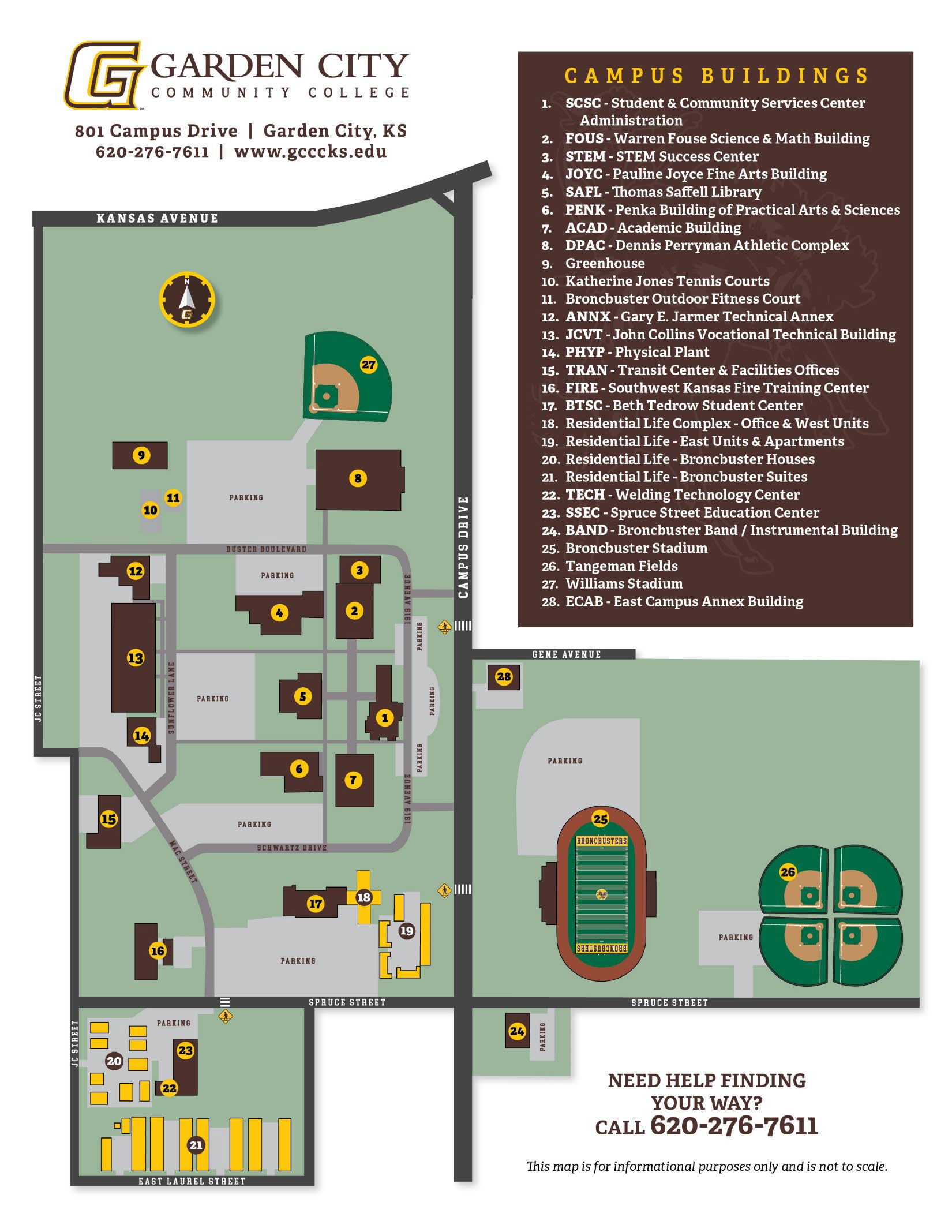
On-campus living facilities are currently available for 444 students. Living choices include West Hall, East Units, Broncbuster Houses, Apartments, and Broncbuster Suites. Campus housing includes lounges with vending machines, ice machines, mailboxes, laundry facilities, and limited kitchen areas.
ADA Facilities
Facilities are available to meet the needs of residents requiring ADA specialized housing. Residents requiring special accommodations should contact the Coordinator of Accommodations prior to check in at 620-276-9638.
Amenities
All housing facilities are heated and air-conditioned. Each bedroom is equipped with extra-long twin bed, drawers, closet, window blinds, as well as wireless internet for each resident, and smoke alarms.
When students check in, a Resident Assistant will take you to your room and living space. At that time you will need to acknowledge any damages in the room on the room condition sheet. You are responsible for your room and its cleanliness, all of the furnishings, windows, screens, floors, walls, and doors. Beds, mattresses, dressers, desks and chairs (unless damaged) are to remain in the same rooms. Window screens are to remain on the windows at all times.
Furniture
Furniture in the bedroom, lobby, and living room areas of all buildings are to remain in the bedroom, lobby, and living room areas. No College furniture is to be outside for any reason. All furniture shall remain upright and utilized for the purpose it is intended for. No furniture brought in by residents will be allowed. Only electric keyboards allowed. Any unapproved furniture will be removed by the Residential Life staff and a hauling fee will be charged to the responsible student(s). Please plan on using the twin sized bed that is provided. A statement from a medical doctor is required if a special mattress/bed is to be brought from home.
Electrical Appliances
Because of the fire hazard caused by overloading circuits, only small electrical appliances are permitted in the rooms. Microwave cooking and air frier only in West Hall, East Units and Houses. Hot plates, open coil cooking devices, deep fat fryers, stoves or propane grills of any kind are prohibited. There is a charcoal grill for public use located West of the Beth Tedrow Student Center by the basketball court.
Porches and Balconies
Porches and balconies will be clear of furniture, debris and trash receptacles at all times. Appropriate decorations will be allowed with prior approval from the Director of Residential Life.
Identification Card (GCCC ID)
It is your responsibility to keep your GCCC ID card or photo ID with you at all times. Students will be required to produce your GCCC ID when asked to by Residential Life staff or Campus Police. Lost GCCC ID cards must be reported to the Campus Police Department and to purchase a new one from the Broncbuster Bookstore for $5.00. GCCC ID must be scanned before students are allowed to enter the cafeteria. DO NOT allow anyone else to use your ID. Any guests at the Residence Halls could be asked to produce a photo ID. Please encourage them to have one with them when they visit.
Laundry
Laundry facilities are located in the east lounge, west end of house G, all suites and on all floors of the west hall. Laundry facilities are to be kept clean at all times. Avoid leaving dirty clothes in your room. Washing facilities exist for the convenience of on-campus residents only. Do not abuse the equipment or leave your laundry unattended. Clothing/items left for 48 hours or more will be donated to local charities. Please clean the dryer lint filter after each use. If washers or dryers do not work properly contact the Residential Life Office, (620)276-9516. However, all residents are expected to cooperate in helping keep these facilities clean. Misuse or abuse of laundry machines or theft of services from laundry machines is prohibited. Such behavior will result in the individuals responsible being billed for the repair of the machines, restitution, and disciplinary action taken against them, up to and including dismissal from the residence halls. GCCC is not responsible for lost or stolen laundry or supplies.
Mail Service
Each resident will be assigned a mailbox. Mail will be distributed once daily, usually by 7:00 p.m. There is a postal drop by the mail center where outgoing mail is picked up daily, Monday - Friday. Your mailing address is:
Your Name
611 Campus Drive
Garden City, KS 67846
Please do not add your box number or room number to the mailing address as it may end up at the Post Office downtown in a PO box!
Shipping Service
There are many options for shipping packages:
- Mail It Etc. (show GCCC ID for a discount) 1816 Palace Drive 620-275-7152
- United States Postal Services (USPS) 410 N. 6th Street 1-800-275-8777
- United Parcel Service (UPS) 2713 N. 11th Street 1-800-742-5877
- FedEx Ship Center 335 N. Air Links Road 1-800-463-3339
Maintenance
All requests for new light bulbs, minor repairs, electrical or plumbing should be reported to the Residential Life Staff and/or RA station during operational hours, except in case of emergency. Call (620)276-9516 during office hours or (620)805-4999 after 5:00 PM to report. You can also fill out a Maintenance Work Order Request Form. Please report emergencies to the Residential Life Staff immediately.
Custodial Services
In West Hall, custodial personnel are responsible for the general cleaning of the hallways and bathrooms Monday through Friday. Residents are responsible for room cleaning and for dumping any trash in the dumpsters located in the parking lot.
East Unit bathrooms are cleaned bi-weekly, Tuesday and Thursday, by custodial personnel if they are picked up and personal belongings are not in the way. Residents are responsible for the rest of the unit including cooking areas and hallways. Residents are responsible for cleaning their room and for dumping any trash in the dumpsters located in the parking lot.
Broncbuster House bathrooms are cleaned weekly by custodial personnel if they are picked up and personal belongings are not in the way. Residents are responsible for the rest of the house including dining area, living room and hallways. Residents are responsible for cleaning their room and for dumping any trash in the dumpster located in the parking lot.
Apartment and Suite residents are responsible for cleaning their areas including the bathrooms, as there is no custodial support.
The College will not be responsible for items left in common areas such as bathrooms that are damaged or thrown away as trash. Cleanliness inspections will be conducted randomly in the common areas of the Apartments, Units, Houses and Suites.
Trash
All residents are responsible for bagging and hauling their own trash to the dumpsters located in the parking lot. Do not leave trash outside the door, in hallways, bathrooms, common areas, on balconies or in stairwells. Do not drop trash over the edge of upper balconies. Cleanliness Fines will be handed out by the Residential Life Staff. Trash bags can be picked up in the Residential Life office or RA station located in the mailbox lobby.
Trash Bags and Toilet Paper
The College will furnish trash bags and toilet paper for the Units, Apartments, Houses and Suites. You may get trash bags and toilet paper from the Residential Life Office during operational hours or the RA station.
Cleaning Supplies
Residents can request cleaning supplies from the Residential Life office during office hours. Students must turn in their College ID to check out items. Cleaning supplies available are vacuum, mops, buckets, brooms and dustpans, floor cleaner, all-purpose cleaner, window cleaner, and sink cleaner.
Equipment or supplies not returned will be billed to the account of the resident who checked them out. Any equipment damage, loss, or unreturned equipment questions will be dealt with at that time. Repair or replacement of damaged equipment will be billed to the responsible parties.
Professional Cleaning Services
A warning will be issued if the common areas (living/kitchen and bathrooms) of the Units, Apartments, Houses and Suites are not kept clean. If a second warning is issued, a professional cleaning service will be hired. The cost will be split equally among the Unit, Apartment, House and Suite residents. This action will be at the discretion of the Director of Residential Life after written warning has been issued to the residents in that area.
Exterminators
Professional exterminators spray areas, including individual rooms, usually on the 2nd Monday of each month. Residents do not have to be present to have your area treated. We suggest clearing the floors of all belongings to ensure more effective treatment. Each residence hall is treated on a three-month rotation.
Operational Hours (Fall & Spring)
Housing Office hours are as follows:
- Monday-Thursday: 8:00 a.m. - 12:00 noon, 1:00 p.m. - 4:30 p.m.
- Friday: 8:00 a.m. - 12:00 noon, 1:00 p.m. - 4:00 p.m.
West Hall exterior doors will close at 10:00 PM Sunday through Thursday and midnight Friday and Saturday. The lobby doors will close at 10:00 PM, or at an arranged time satisfactory with all staff on duty.
Operational Hours (Summer)
Housing Office hours are as follows:
- Monday-Thursday: 8:00 a.m. - 12:00 noon, 1:00 p.m. - 4:00 p.m.
- Friday: 8:00 a.m. - 12:00 noon
West Hall exterior doors will close at midnight every day. The lobby doors will close at 11:00pm, or at an arranged time satisfactory with all staff on duty.
Parking and Parking Permits
All vehicles belonging to, or that are used by residents must be registered in the Residential Life Office. Resident parking lots are located directly south of the Student Center complex, between the Suite buildings and in the middle and east of the Houses. Please observe the 10-mph speed limit in the parking lot. Parking permits will be issued to each student who registers a vehicle. The permit is to be hung on the back of the rear-view mirror at all times with the number visible for security purposes.
Anyone who drives a motor vehicle (automobile, truck, motorcycle, scooter, etc.) must adhere to campus regulations and state laws governing such vehicles. All Scooters and motorcycles must be registered in Res-Life office at check-in. The campus is located within city limits of Garden City and all local and state laws apply.
Vehicles, bicycles, and motorcycles are prohibited on sidewalks. Vehicles parking in designated handicapped stalls must display a valid handicap permit or license plate. Violators can be fined up to $500. Please note there are restricted parking stalls in the lots such as maintenance, loading zones, fire lanes, and stalls reserved for professional staff. Violators' vehicles can be issued district citations and/or towed at the expense of the owner.
Please park in the designated painted parking stalls and not in the fire lanes or driving areas adjacent to the fire lanes or driveways. Park only in designated yellow lined stalls. Vehicles that do not display a Residential Life parking permit, or are wrecked, improperly tagged, no longer run, or are abandoned, will be reported to Campus Police. Abandoned vehicles may be towed to the Garden City Police Impound lot after 14 days at the owner’s expense.
Campus E-Scooter Policy
This policy outlines the guidelines for the use of non-ADA electric scooters (hereinafter referred to as "e-scooters") on Garden City Community College campus. This policy aims to balance the potential benefits of e-scooters with the need to ensure the safety and accessibility of the campus environment for all members of the College community.
A Non-ADA Electric Scooter is defined as any personal or rented motorized vehicle, including but not limited to electric scooters, bikes, hoverboards, electric skateboards, and similar devices, that are not designed for and do not meet the Americans with Disabilities Act (ADA) accessibility standards.
This policy outlines rules for all non-ADA motorized devices (e-scooters, e-bikes, hoverboards, and e-skateboards) on campus to ensure community safety. Gas scooters are strictly prohibited.
Riding Rules
- Where: Ride only outdoors. Riding inside any building is strictly prohibited.
- Traffic: Obey all traffic rules and stay to the right on roads and sidewalks. Maintain a safe and reasonable speed.
- Pedestrians: Yield to pedestrians and give an audible or hand signal when passing.
- Passengers: Only one rider per scooter. No tandem riding.
- Safety: Do not ride recklessly or during bad weather. Helmets are strongly encouraged.
- Night: Front white and rear red/amber lights are required for night riding.
Mandatory Registration
- Requirement: All students, faculty, and staff must register their device to receive an official decal.
- Commuters: Register at the Campus Safety & Security Office.
- Residents: Register with the Director of Residential Life.
- Tip: Keep a photo and the serial number of your scooter in a safe place.
Parking & Storage
- Inside: Allowed only within your own residence hall room or apartment.
- Outside: Park upright on hard surfaces, preferably secured in a bike rack.
- Prohibited Areas: Do not block doorways, stairs, sidewalks, hallways, turf, or flower beds.
Violations & Penalties
The registered owner is responsible for any damage or violations, regardless of who is riding.
- 1st Offense: Written warning.
- 2nd Offense: $100 fine and scooter confiscation until paid.
- 3rd Offense: Permanent loss of campus riding privileges and immediate impoundment.
Traffic Laws and Rules
All local and state regulations are in effect on campus 24 hours a day. In addition to Campus Police, city, county, and state law enforcement agencies have jurisdiction on campus. All laws and regulations are strictly enforced to ensure safety. Please observe these laws and drive with courtesy. A lack of knowledge of these regulations is not a defense.
Campus Police
The Garden City Community College Campus Police Department is committed to providing a safe and secure learning environment for students, faculty, staff, and the general public while on campus, or in any facility owned or operated by the College. We will achieve this through community partnerships, education, planning and the enforcement of state and local laws. The Garden City Community College Campus Police strive to create a level of professionalism, service, and excellence in law enforcement to become the premier College police agency in the nation. We strive toward promoting the following core values: Trust, Integrity, Compassion, Professionalism, Teamwork, Ethical Behavior, Diversity, Fair and Equal Treatment. Campus Police Officers enforce State and local laws as well as GCCC rules and regulations. They also provide valuable services to students such as:
- Emergency Vehicle Unlocks: You know that sick feeling you get when you lock your keys in your car? Campus Police can help by unlocking your vehicle for you, free of charge, unless your car is equipped with electronic locks.
- Bicycle ID: A complete description of your bike is recorded, a photo taken, and your unique ID number engraved on it.
- Police Safety Escorts: Campus Police Officers are on campus to keep all students safe. If you would like a police safety escort anywhere on campus, please call 620-276-9536 (office) or 620-272-6828 (cell). If officers are on duty and are available, they will assist you. Due to other calls for service, there might be a delay.
- Vehicle Jump Starts: In situations where your vehicle needs a jumpstart, Campus Police will assist you if officers are on-duty and available. Due to other calls for service, there might be a delay.
Procedures for Reporting Emergencies or Crime On-Campus
All emergencies involving a crime in progress, a medical emergency or a fire should be immediately reported to 911. All campus phones may be used to dial 911 at no charge. While on campus, please be aware that different telephone systems might require you to dial an outside line (8) before dialing 911.
To report any non-emergency incident occurring on campus, call the Campus Police at 620-276-9536 (office) or 620-272-6828 (cell). When calling for any reason, be prepared to:
- Clearly identify yourself
- State where you are calling from
- State briefly the nature of your call
If possible, stay on the line unless otherwise advised by the officer or dispatcher. The appropriate service will be dispatched for you.
To report an incident of discrimination, harassment, or sexual violence contact the Title IX Coordinator, Kellee Munoz at 620-276-9574, kellee.munoz@gcccks.edu or use the online Safety Assessment Form.
Members of the College community are strongly encouraged to report all crimes and suspicious activities to the Campus Police or the Garden City Police Department in a prompt and timely manner.
Power Failures
In the event of a power failure, emergency lights will be activated. Remain calm and do not use candles. Keep hallways and exits clear from obstruction. Residential Life staff, maintenance and campus police have procedures in place in the event of a lengthy power outage. Backup generators are available to maintain a comfortable temperature in the cafeteria as well as power the kitchen equipment. In the event of an anticipated power failure due to incoming weather, instructions will be emailed or sent out using the emergency notification system.
Campus Crime Disclosure Act
In compliance with the Jeanne Cleary Disclosure of Campus Security Policy and Campus Crime Statistics Act, GCCC collects and reports specific information on campus crime statistics, campus security policies and is required to inform the campus community where information concerning registered sex offenders can be obtained. The College’s Annual Security Report as well as a link to the KBI’s Registered Offenders list can be accessed on the College’s web site at www.gcccks.edu or by directly going to the KBI site at www.accesskansas.org/kbi/ro.shtml. To obtain a printed copy of the Annual Security Report, which is distributed each October, contact the Campus Police Chief at 620-276-9536 (office) or 620-272-6828 (cell) located in the SCSC building, Room 2013.
Student Health Services
The College employs a full-time Student Health Nurse. This office is in the northwest corner of the Beth Tedrow Student Center.
Monday – Friday 8:00 a.m. - 4:30 p.m. (Summer hours may vary)
In case of emergency, the Director of Residential Life, Assistant Director of Residential Life, Residential Life Advisors, Residential Life Office Manager, Residential Life Coaches or RA will contact emergency medical services. All emergency sicknesses are to be reported to the Health Nurse and or the Director of Residential Life. Each student residing in College housing, or any student requesting health services, will complete a personal data sheet. This sheet will contain information that may be used in case of an emergency for the student. Each student living in the residence halls is required to have an immunization record on file with proof of MMR#2 and meningitis vaccination/waiver per Kansas State Law (HB 2752).
All services in the student health office are free to students unless otherwise specified. Services offered include weight and nutrition information, literature on health issues, doctor and dental referrals, blood pressure and/or weight checks, birth control information, pregnancy testing, and general first aid supplies. Over-the-counter medication is available on a self-serve/self-request basis.
All conversations and/or records in the Health Services Office are strictly confidential.
Counseling Services
There are FREE counseling services available to all GCCC students. Please reach out:
- JoAnn Garrier, LPC, NCC, GCCC Counselor: 620-276-9635 located in SCSC
- Genesis Family Health: 620-275-1766 located in BTSC
- Family Crisis Services: 620-275-5911
Here are a few signs to look for if you or someone you know may need help:
- Talk of self-harm
- Negative self-talk
- Socially withdrawn
- Changes in sleeping habits
- Low energy
- Extreme weight change
- Easily irritated
- Lost interest in hobbies or activities
- Unexplained bruising or visible signs of abuse
- Drastic mood swings
There are several services in place for anyone experiencing a mental health incident or crisis. The College is devoted to the safety and wellbeing of all students.
For those experiencing a crisis, the Residential Life Staff are always available to talk, and to connect students with campus and community resources.
If your or your roommate is experiencing a mental health crisis, then you should:
- Call 911 (Local Emergency Services) or 988 (Suicide and Crisis Lifeline)
- Call the Residential Life Office (8:00am-4:30pm)
- Call the Residential Assistant Phone (if after 5:00pm) and report what’s going on and where you are
- Get to a safe place (Hallway, common rooms, outside)
Wait for someone to get there and wait for further instructions. Important numbers to know:
- Emergency Services: 911
- Residential Life Office: 620-276-9516
- Residential Assistant: 620-805-4999
- Residential Life Supervisor: 620-276-9517 / 620-276-9518
- Suicide Prevention Hotline: 800-273-8255 or text/call 9-8-8
- Genesis Family Health: 620-275-1766
- Family Crisis Services: 620-275-5911
Health and Hospitalization Protection
The College does not have a student health insurance program. Students who do not have health and hospitalization protection covered by their parents' or spouse's policies are responsible for their own health insurance coverage, and the College assumes no responsibility for health insurance plans. Insurance information from several companies is available at the Health Services Office.
Immunizations
All residence hall students are required to have their immunization records on file with both the Residential Life Office and the Health Services Office. In addition, each student is required to have the following: a TB skin test within the past year if specified by the TB screening process and a second measles, mumps and rubella injection. A tetanus booster is recommended within the past 10 years. Under Kansas State Law (HB 2752), all students living on campus must submit proof of having the meningitis vaccination or have a signed waiver refusing the vaccination. All records will be checked, and all students must be in compliance by September 15 (fall semester), February 15 (new spring residents) or a hold will be placed on your academic records.
INTERNET USE POLICY
Internet service is available to all residence hall students. IMPORTANT: You will be held accountable for any/all activity associated with the login and password issued to you. Do NOT give out your login or password, as you are ultimately responsible for what is accessed on the internet with it.
Prohibited use of the College network includes:
- Representing yourself electronically as another user
- Unlawfully harassing others
- Posting or mailing of obscene material
- Making, distributing, or using unauthorized copies of licensed software
- Copying and illegal distribution of copyrighted songs and movies is not permitted, nor is the operation of peer-to-peer software that supports these activities. Examples of peer-to-peer software include, but are not limited to LimeWire, Aries, Gnutella, Kazaa, Morpheus, eDonkey, eMule. (See Internet, Intellectual Property, and Copyright Infringement below)
Use of GCCC’s computer resources is a privilege, not a right. Any violation of computer usage policies will be investigated. Substantiated violations will result in disciplinary action, including termination of access without notification, disciplinary review, expulsion, or other sanctions deemed appropriate. Some violations may constitute criminal offenses as outlined in Kansas statutes and other local, state, and federal laws; the College takes seriously its responsibility to report such violations to the proper authorities.
If IT detects a student has been participating in illegal file sharing or downloading, the following actions will be taken:
First Offense: Loss of internet service for two weeks.
Second Offense or Takedown Notice Received: Loss of all internet privileges for remainder of academic year.
The Internet, Intellectual Property, and Copyright Infringement - The Digital Millennium Copyright Act (DMCA) of 1998 is a federal law that is designed to protect copyright holders from unlawful reproduction or distribution of their works. The DMCA covers music, movies, text and anything that is copyrighted.
One of the biggest culprits of copyright infringement is peer-to-peer file sharing programs and sites. These may include LimeWire, Gnutella, Kazaa, and others. These sites allow the exchange of often copyrighted material (most commonly music) and often give others access to files on your computer and personal information. Please be aware that when you sign up for service on some of these sites (example LimeWire) you are purchasing a software license, NOT the right to share music or other copyrighted material. Peer-to-peer sites and software are also notorious for being the source of malicious viruses, spyware and other malware.
You could violate federal copyright law if:
- Somebody e-mails copyrighted material to you and, in turn, you forward it
- You make an MP3 copy of a song from a CD that you bought (purchasers are expressly permitted to do so) but subsequently make the MP3 file(s) available on the Internet using a file-sharing network.
- You join a file-sharing network and download unauthorized copies of copyrighted material you want from the computers of other network members.
- To gain access to copyrighted material on the computers of other network members, you pay a fee to join a file-sharing network that is not authorized to distribute or make copies of the copyrighted material. You then download unauthorized material.
- You transfer copyrighted material using an instant messaging service.
- You have a computer with a CD burner that you use to burn copies of music you have downloaded onto writable CDs which you then distribute to your friends.
- A simple rule of thumb to help you identify which materials are protected by copyright and which are not: If you would typically pay for it, then it is probably protected.
Complaints typically arrive directly from software, music and motion picture associations, copyright holders and law firms. Information Technology Services disables network access for the devices registered to the individual identified. IT will contact the student if Garden City Community College is notified of a violation of copyright law to inform him or her about the complaint.
Personal wireless access points are not allowed on campus. Wireless access points plugged into the campus network could download a version of firmware that will render them unusable. GCCC is not responsible for any damage caused to wireless access points plugged into the GCCC network. Illegal wireless access points will be confiscated and can result in fines.
Food Service
The cafeteria is under the direction of a Food Service Director. The College contracts with a professional catering company, Great Western Dining. Food service is available to students, faculty, staff, and guests. Board is included in the housing contracts of all residents providing 19 meals per week.
Meals are all you can eat in the cafeteria with the exception of sack lunches; sit down served meals and special dinners. With the exception of ice cream cones or fresh fruits; no other food, drinks, or dishes are to be carried out of the cafeteria without express permission from the Food Service Director. Abusing this privilege will result in the restriction of ALL food from leaving the cafeteria. Meals are not served or have alternative serving dates during four vacation periods: Thanksgiving, Christmas, Easter weekend and Spring Break. For checkout and travel convenience, sack lunches will be served for the last meal prior to the above vacations. Residents who are ill can get to-go meals with a request from the health nurse or the professional staff to the food service director. Guests are welcome but they must purchase a meal to be in the cafeteria. Sack lunches are available if you have scheduling conflicts. Please contact the Food Service Director in regard to this, 620-276-9607.
Misuse of the meal plan can result in temporary or permanent loss of eating privileges with no refund and/or added charges to the board contract. Inappropriate behavior in the cafeteria that results in permanent suspension from the cafeteria will result in contract termination. Your friends are welcome to eat with you in the cafeteria if they purchase a meal. Meal plans for off-campus residents may be purchased in the Residential Life Office.
| Meal | Days | Hours |
|---|---|---|
| Breakfast | Monday - Friday | 7:00 a.m. - 9:00 a.m. |
| Lunch | Monday - Thursday | 11:30 a.m. - 2:00 p.m. |
| Lunch | Friday | 11:30 a.m. – 1:00 p.m. |
| Lunch/Brunch | Saturday - Sunday | 12:00 noon - 1:00 p.m. |
| Dinner | Monday – Thursday | 5:00 p.m. – 6:45 p.m. (After Football Season: 5:00 p.m. - 6:30 p.m.) |
| Dinner | Friday - Sunday | 5:00 p.m. - 6:00 p.m. |
| Meal | Days | Hours |
|---|---|---|
| Continental Breakfast | Monday - Friday | 9:00 a.m. - 9:30 a.m. |
| Lunch | Monday - Friday | 12:00 noon - 1:00 p.m. |
| Dinner | Monday - Friday | 5:00 p.m. - 6:00 p.m. |
FOOD SERVICE IDENTIFICATION CARD
You must have your student ID card to eat and only you can use it.
Your food service identification card will be your student ID that you received from
the bookstore. If you lose your eating privileges because of disorderly conduct, vulgar
language, excessive loudness, leaving trays, dirty tables, abuse of or misuse of food
service plan, verbal abuse of personnel, non-payment, etc., your food service privileges
will be removed and eating privileges will be reinstated only when the problem is
resolved with the Food Service Director and the Director of Residential Life. Excessive
loudness by individuals in the Cafeteria can result in a written noise complaint and
will be treated as such. If you are removed from the Residential Life area permanently
it will be determined at that time if you will still have food service privileges
in the cafeteria.
If you lose your ID card, report it immediately to the residential life office so your food service privileges can be reinstated on a new card that you must purchase for $5 from the bookstore. GCCC will not be responsible for lost ID cards used by unauthorized people. It is your responsibility to keep track of your ID card.
Special Diets—If you are on a special diet for medical or religious reasons, see the Food Service Director or the Director of Residential Life. Accommodations will be made so you can eat in the cafeteria.
Cafeteria Rules
- Your GCCC ID must be scanned at every meal, or you WILL NOT be served. This ID is not transferable to anyone.
- Do not try to enter cafeteria before or after posted mealtimes. If you have a schedule conflict, contact the Foodservice Director to discuss options.
- You must wear appropriate clothing at all times while you are in the cafeteria.
- Shirts, pants and shoes must be worn at all times
- No undergarments should be shown, including Spanx or sports bras.
- No shirts with cut-off sleeves.
- Do not cut in line.
- Do not waste food! If you do not want it, do not ask for it or take it.
- Do not throw food or anything else in the cafeteria.
- Food cannot be removed from the cafeteria except the grab-n-go meals, fresh fruits or ice cream cones. Unless restricted by the Director of Residential Life or Foodservice Director.
- NO OUTSIDE FOOD OR BEVERAGES ALLOWED IN THE CAFETERIA.
- No cafeteria furniture can be removed from the cafeteria.
- When you have finished your meal, carry your tray to the dish washing room. Do not leave your dishes, cups, utensils, used napkins or trays on tables.
- Backpacks are not allowed in the cafeteria area. Please take them to your room or put them on the shelves along the North wall of the cafeteria. Not on the floor or tables.
- Do not be on the phone or listening to music when going through the serving line. Take off your headphones so you can clearly hear the food service staff. Also, speak clearing when asking for food items.
- The volume on iPads, iPods, Laptops, phones or any other electronic device should be low enough as to not disturb others in the cafeteria. Please use headphones if you would like to have the volume higher.
Your cooperation in practicing respectful and responsible dining conduct promotes cheerful service. Violation of the above rules can result in monetary fines and/or dismissal from the Residence Halls.
CONTRACT INFORMATION AND RESPONSIBILITIES
CONTRACT AGREEMENT
The contract is either a two-semester agreement for the academic year or a one-semester agreement for the spring semester. There is substantial cost for early termination, refer to the cancellation schedule of the contract for details (Residential Life Office Contract Cancellation Schedule). Rooms are not reserved until the application, and the $125 non-refundable payment is completed.
DAMAGES
The resident agrees to reimburse the College for damages if defacement of the premises occurring during this agreement is above normal wear and tear. The resident is also liable for damages to the premises that may have been caused by an act or omission of the resident and the residents’ guests, as allowed by applicable law. The resident has the right to receive from the College a copy of the list of all existing damages to his or her room if a written request is made within 15 days of termination of occupancy.
Charges will be assessed immediately upon the determination of the cost of repairs or replacement for damage to any of the areas, furnishings, or equipment provided by the College and will be apportioned as follows:
- To any individual(s) identified as contributing to the damage.
- To the resident(s) of a room wherein the damage was done, and direct responsibility cannot be placed.
- To the residents of a building, apartment, unit, house, or suite, where the damage was done, by an equal assessment of each resident of that area where direct responsibility cannot be placed.
- The Director of Residential Life reserves the right to inspect all areas after students have departed. Damages noted by staff members when you check out of your room are tentative and additional damage, cleaning, or hauling charges may be assessed at the discretion of the Director of Residential Life.
CANCELLATION OR TERMINATION OF CONTRACT
Conditions of termination of the contract are explained in the contract (refer to copy of contract in this handbook). A resident may terminate the contract by giving written notice to the Director of Residential Life according to terms of the contract. The College explicitly reserves the right to cancel a contract either before or while the student occupies the room. If a resident is dismissed from the Residential Life Area, the contract is automatically terminated. Damage assessed will be billed on the students’ account in the Business Office. Upon termination, students are expected to vacate and remove personal possessions within ninety-six (96) hours or less as deemed necessary by the Director of Residential Life for safety or health reasons. Personal property not removed at that time will be disposed of, without liability to the College or any personnel.
Approval of contract cancellation will be automatic if any of the following criteria are met:
- The resident graduates from GCCC
- The resident withdraws from GCCC or does not enroll in over 8 semester hours for the length of the current Residence Hall Contract.
- The resident gets married and resides with his or her spouse. A copy of the marriage certificate must be submitted for the student file.
- Immediate vacation is recommended by the Director of Residential Life and approved by the Vice President of Student Services for safety reasons.
- A resident moves in with parent(s) and resides with parents for the remainder of the contract year. Appropriate paperwork must be obtained from and returned to the Office of Residential Life.
This summary of the contract terms is intended to be informative only, and nothing herein shall be deemed to modify, amend, or alter the terms and conditions of the contract. You are advised to refer to the express contract provisions.
CANCELLATION CHARGE REFUND APPEAL PROCEDURE
Students wishing to appeal cancellation charges must complete a “Residence Hall Cancellation Charge Appeal” form and return it with appropriate documentation to the Business Office within one week of the official checkout date.
Ruling on the appeal will be determined by a committee consisting of representatives from the Business Office, and Student Services. The student will be notified, in writing, of the committee’s decision.
Vacancies
Residents are not required to vacate for Thanksgiving or Spring Break. RAs will conduct a room-to-room survey to determine who will be staying over holiday breaks. Visitation hours during vacations are 10am – 12am midnight daily, including weekends. Violation of College or residence hall policy during holiday breaks will result in the resident or residents involved being removed from the halls immediately and not allowed back for the duration of the holiday break. If that resident is representing the College in an activity the appropriate coach or sponsor will be called and they will be required to come and get them immediately. Residents that are required to stay through breaks to officially represent the College will need to be fed by the department they are representing if food service is not available. Food service hours will be determined on a year-to-year basis. All keys will be collected from the students as they leave for the Christmas Break. A fine of $50 will be assessed to residents not turning in their keys. No one is allowed to remain over Christmas break. Exceptions to this are: 1) students officially representing the College for College-sponsored activities during the Christmas break and only if the head coach or advisor notifies the Residential Life Office in writing prior to the vacation period, 2) international students with prior approval and arrangements made before November 15th through an application process available in the Residential Life office.
KEYS
When you check into the residence halls, you will be issued keys to your room, outside doors and mailbox. Keep your door locked at all times. If you should lose a key, report the loss to the Residential Life Office IMMEDIATELY. The College is not responsible for lost or stolen keys or losses resulting from it. A temporary duplicate key can be issued to the resident if the appropriate paperwork is completed. The student will be responsible for the cost of a second key ($65). There will be a $5-$25 charge to the resident each time a staff person has to unlock a door for any resident after the 2nd time no matter what the reason. Forcing, kicking, or pulling doors open that are locked will result in a fine for persons involved. Your keys are to always be in your possession and are not to be given to other residents or guests to use when you are not with them. Living quarters should be kept locked at all times. The College will not assume responsibility for stolen items. Lost keys will be assessed at $65 each. Room or mailbox keys are not to be given to other residents or guests.
KEYS AND HOLIDAY BREAKS
All room keys will be turned in, if requested by the Director of Residential Life before Christmas Break. A fine of $50 will be assessed to residents not turning in their keys. If your key is lost, you will need to make arrangements with the Residential Life Office to have the lock changed and a new key made. A $65 charge will be billed to your account for the replacement cost of the key before you leave.
ROOM ASSIGNMENT AND CHANGES
Every attempt will be made to honor requests for roommates and rooms from all applicants. Room or roommate change requests cannot be made until after the 25th day after the official move in date. All room or roommate change requests must be approved by the Director of Residential Life. Unapproved room changes will result in a $100 fine and the student moving back to their originally assigned room. Beds, mattresses, dressers, desks, and chairs are to remain in the same rooms as placed at the start of the school year. The Director of Residential Life reserves the right to reassign and/or adjust occupancy of a room at any time. Residents who have personality conflicts and cannot live with or refuse to live with the available roommates will be charged for a single room. Room change requests and room preferences will be honored, if at all possible, at the discretion of the Director of Residential Life. In case a contracting occupant vacates a room, the remaining student agrees to accept another roommate as assigned, move into another room if required, or pay the private room rate, as determined by the Director of Residential Life.
ROOMMATE – AGREEMENTS & CONFLICTS
Having a roommate can be one of the best experiences of College life. How you approach it will determine whether you have a positive roommate experience. A willingness to share, communicate and work through conflicts will play a big part. Roommate agreements can be picked up from the residential life office. The following are the rights of you and your roommate:
- The right to study free from undue interference in one’s room. Unreasonable noise and other distractions inhibit the exercise of this right.
- The right to sleep without undue disturbance from noise, guests of roommate, etc.
- The right to expect that a roommate will respect one’s personal belongings.
- The right to a clean environment in which to live.
- The right to free access to one’s room and facilities without pressure from a roommate.
- The right to personal privacy.
- The right to host guests that respect the rights of the host’s roommate and other hall residents.
- The right to talk through conflict and concerns (Residential Life staff are available to assist mediating conflict resolutions).
- The right to be free from fear of intimidation, physical, and/or emotional harm.
BYSTANDER ENGAGEMENT
The Residential Life staff encourages students to offer help and assistance to others in need. Student survivors, witnesses and bystanders who report, in good faith, any incident of sexual assault, domestic violence, dating violence or stalking will be granted amnesty. As well as for those that assistance in an emergency. While policy violations cannot be overlooked, the College can provide educational options, rather than punishment to those who offer their assistance.
STORAGE AND ABANDONED ITEMS
The College is not responsible for damage or loss of abandoned items. No storage space is available. Items left more than 48 hours after the resident has left will be disposed of at no liability to the College. Items left will not be shipped home. Items will be released to a third party only with written authorization sent to the Director of Residential Life. During Thanksgiving, Christmas and Spring breaks items may be left in your rooms for the duration of the break. Residents who are not returning for the spring semester must take all items with them when they leave in December. Summer residents must also remove all personal items when they leave. Several storage unit places are available to rent in Garden City.
PAYMENTS
The failure to make residence hall payments will result in the student being required to vacate the halls. Please make payment arrangements with the GCCC Business Office. Meals denied due to non-payment are not refundable.
TRANSCRIPT HOLD
If a student is delinquent on an account to the College, including but not limited to unpaid housing contracts, damage costs, cleanliness/trash fees, lost key costs, and/or disciplinary fees a hold will be placed upon the student’s records by the Director of Residential Life. Transcripts will only be sent by the Registrar’s Office with written authorization from the Director of Residential Life, stating that the obligation has been cleared or paid.
DAMAGES TO OR LOSS OF PERSONAL PROPERTY
Residents are urged to provide for his or her own protection against loss or damage to person or property and for his or her personal liability. Most homeowner’s policies cover any loss, but it is wise to check with your parents on each individual policy. Fire, flood, lightning strikes, leaking windows, broken pipes, faulty equipment, or accidents resulting from maintenance, custodial, IT, or RAs, performing their job duties in your area that damages or destroys residents’ personal items are examples of loss/damage that can only be replaced if you have your own insurance covering these items. The insurance carried by the College covers College property only, not property of those living in the residence halls. Claims for injury or damage to persons or property and personal liability resulting from negligence, wrongful acts or omissions of the College and its employees acting in the course of their employment are covered by the terms of the Kansas Tort Claims Act, K.S.A. 75-6101 et seq.
CHECKING INTO RESIDENCE HALLS
When you arrive on campus, go to the Residential Life Office located in the lobby of the Student Center to receive check-in instructions. When checking in to the room any concerns should be discussed with the Director of Residential Life to the satisfaction of both parties.
UNAPPROVED EARLY CHECK-IN WILL RESULT IN THE RESIDENT BEING BILLED $50 PER 12 HOURS PRIOR THE OFFICIAL OPENING OF THE RESIDENCE HALLS BOTH FALL AND SPRING SEMESTERS.
CHECKING OUT OF RESIDENCE HALLS
- Any student moving out of the halls must use the following checkout procedure:
Inform the Residential Life Office that the resident is moving out of the residence halls. - You are Responsible to Clean your room! Cleaning supplies are available in the Residential
Life Office.
- Dust shelves, inside of closet, clean out drawers.
- Take any trash from your room/common areas to the dumpster – not to bathrooms or hallways.
- Remove tape or any foreign substance from walls and doors and scrub them clean if they are dirty.
- Sweep and mop floors – including under your bed.
- If you live in an apartment or unit, bathrooms, living rooms, and kitchens must be cleaned.
- Turn in room key to the Residential Life Office.
- Clear all financial obligations with the Business Office and Financial Aid Office.
- Failure to clean your room or dispose of trash will result in a minimum fine of at least $25 per person per area cleaning and/or hauling fee.
- Each room must have two bed frames, two mattresses, two appropriate desk chairs, dressers, and desks only before finalizing checkout. If anything else is left, such as personal items, trash or extra furniture a hauling fee will be assessed to each occupant of the room.
- Apartments, Units, Houses and Suites must have the designated lounge furniture and kitchen furniture before finalizing checkout. If anything else is left, such as personal items, trash or extra furniture a hauling fee will be assessed to each occupant of the Unit or Apartment.
- Smoke alarms, fire extinguishers, commons area damages, and each room will be checked and after all residents have checked out and any damages assessed accordingly.
- The Director of Residential Life reserves the right to inspect all areas after students have departed. Damages noted by staff members checking you out of your room are tentative and additional damage, cleaning, or hauling charges may be assessed at the discretion of the Director of Residential Life.
The residence halls close at 6:00 p.m. on the last day of finals. All residents excluding Resident Assistants, summer school residents or residents with prior approval involved in College-sponsored events will need to have all of their belongings removed by 6:00 p.m.
LATE CHECK OUT WILL RESULT IN THE RESIDENT BEING BILLED $50 AND THEN AN ADDITIONAL $25 EVERY HOUR BEGINNING AT MIDNIGHT OR $100 DOLLARS PER DAY. THIS IS IN EFFECT FOR BOTH THE OFFICIAL CLOSING OF THE RESIDENCE HALLS FOR FALL AND SPRING SEMESTERS.
POLICIES AND PROCEDURES
OBSERVANCE OF POLICIES AND PROCEDURES
It is the responsibility of every resident to respect the rights and privileges of other residents. Residents are also responsible for the behavior and actions of their guests and are subject to disciplinary action for their guests' behavior that is not in accordance with the rules and regulations of college policies. The regulations and guidelines listed in this publication are intended as means for the protection of residents' rights. The authority for these regulations is based upon the legal responsibility authorized by the statutes of the State of Kansas. The residence hall staff promotes compliance with college policies and works with residents to maintain a safe living community. Failure to comply will not be tolerated in the Residential Life Area. Failure to comply includes, but is not limited to: failure/refusal to follow written and/or verbal instructions and requests by any College staff member (including Residential Life staff, Residential Life Coaches, Resident Assistants, Campus Police, maintenance, custodians, food service employees, etc.), verbal altercations, disrespectful actions or comments, general rebellion or repeated actions with or against any College or food service staff member will be regarded as insubordinate attitudes and will be dealt with accordingly with disciplinary action up to and including dismissal from the Residential Life Area.
Repeated failure to comply with these guidelines of conduct and insubordinate attitude toward Advisors, Office Manager, Resident Assistants, Staff Assistants, Assistant Director and/or the Director of Residential Life as well as other personnel assigned to this complex (including maintenance, custodial, campus police, and food service workers) disciplinary action which could result in immediate dismissal from the residence halls and/or the College. Violations against persons or property or the conviction of a crime may result in dismissal from the residence halls. Failure to attend scheduled meetings with the Residential Life staff will be regarded as insubordination and may result in disciplinary action up to and including dismissal from the Residential Life area.
Title IX Non-Discrimination/Anti-Harassment
Garden City Community College (“the College”) is committed to providing a workplace and educational environment, as well as other benefits, programs, and activities, that are free from discrimination, harassment, and retaliation. To ensure compliance with federal and state civil rights laws and regulations, and to affirm its commitment to promoting the goals of fairness and equity in all aspects of the educational program or activity, the College has internal policies and procedures that provide a prompt, fair, and impartial process for those involved in an allegation of discrimination, or harassment on the basis of protected class status, and for allegations of retaliation. The College values and upholds the equal dignity of all members of its community and strives to balance the rights of the parties in the grievance process for all those involved.
The core purpose of this Policy is the prohibition of all forms of discrimination. Sometimes, discrimination involves exclusion from activities, such as admission, athletics, or employment. Other times, discrimination takes the form of harassment or, in the case of sex-based discrimination, can encompass sexual harassment, sexual assault, stalking, sexual exploitation, dating violence, or domestic violence. When an alleged violation of this Policy is reported, the allegations are subject to resolution using the College’s Informal or Formal Grievance Processes, determined by the Title IX Coordinator.
When the Respondent is a member of the College community, a grievance process may be available regardless of the status of the Complainant, who may or may not be a member of the College’s community. This community includes, but is not limited to, students, faculty, administrators, staff, and third parties such as guests, visitors, volunteers, invitees, and campus camp attendees.
The full Non-Discrimination/Anti-Harassment policy can be found here.
1. Title IX Coordinator
The Title IX Coordinator oversees implementation of the College’s Non-Discrimination/Anti-Harassment Policy. The Title IX Coordinator has the primary responsibility for coordinating the College’s efforts related to the intake, investigation, resolution, and implementation of supportive measures to stop, remediate, and prevent discrimination, harassment, and retaliation prohibited under this Policy.
2. Independence and Conflict-of-Interest
The Title IX Coordinator manages the Title IX Team and acts with independence and authority free from bias and conflicts of interest. The Title IX Coordinator oversees all resolutions under this Policy and these procedures. The members of the Title IX Team are vetted and trained to ensure they are not biased for or against any party in a specific case, or for or against Complainants and/or Respondents, generally.
To raise any concern involving bias, conflict of interest, misconduct, or discrimination by the Title IX Coordinator, contact the Garden City Community College President. Concerns of bias, misconduct, discrimination, or a potential conflict of interest by any other Title IX Team member should be raised with the Title IX Coordinator.
3. Administrative Contact Information
Anyone wishing to make a report relating to discrimination, harassment, or notice of alleged policy violations may do so by reporting the concern to the College’s Title IX Coordinator or the Dean of Student Services/Deputy Title IX Coordinator:
Employees / Students
| Kellee Munoz Title IX Coordinator (620) 276-9574 kellee.munoz@gcccks.edu |
Tammy Tabor Dean of Students/Deputy Title IX Coordinator (620) 276-9508 tammy.tabor@gcccks.edu |
Garden City Community College has determined that the following administrators are Officials with Authority (OWAs) to address and correct harassment, discrimination, and/or retaliation. The College has classified all full-time employees as Mandated Reporters of any knowledge they have that a member of the community is experiencing harassment, discrimination, and/or retaliation. In addition to all full-time employees, these OWAs may also accept notice or complaints on behalf of the College.
- Dr Ryan Ruda, President
- Colin Lamb, Vice President of Student Services
- Karla Armstrong, Vice President for Administrative Services/CFO
- Phil Terpstra, Dean of Academics
- Tammy Tabor, Dean of Student Services
- Gordon Schuler, Director of Residential Life
- Rodney Dozier, Campus Police Chief
- Brandy Unruh, Campus Police Officer PT
- Robert Scrivner, Campus Police Officer PT
- Lamar Turner, Campus Safety Officer
- Mark Scheopner, Campus Safety Officer PT
- Lance Miller, Campus Safety Officer PT
Inquiries may be made externally to:
Office for Civil Rights (OCR)
U.S. Department of Education
400 Maryland Avenue, SW
Washington, D.C. 20202-1100
Customer Service Hotline #: (800) 421-3481
Facsimile: (202) 453-6012
TDD#: (877) 521-2172
Email: OCR@ed.gov
Web: http://www.ed.gov/ocr
Kansas City Office
Office for Civil Rights
U.S. Department of Education
One Pettycoat Lane
1010 Walnut Street, 3rd Floor, Suite 320
Kansas City, MO 64016
TDD #: 800-877-8339
Employees may also file complaints of discrimination with:
EEOC Field Office Gateway Tower
400 State Avenue, Suite 905
Kansas City, Kansas 66101
Phone: 1-800-669-4000 TTY: 1-800-669-6820
Fax: 913-551-6957
Kansas Human Rights Commission (KHRC)
900 SW Jackson Street Suite 568-S
Topeka, KS 66612-1258
Phone: 785-296-3206
Fax: 785-296-0589
AMNESTY POLICY
Individuals may be hesitant to report conduct which they have experienced or witnessed, to participate in an investigation and/or grievance proceeding, or to speak truthfully because they fear College disciplinary action due to their own consumption of alcohol or other drugs at or near the time of the incident. While the College does not condone underage drinking or drug use, the College may extend limited immunity from College sanctioning in the case of illegal drug and alcohol use to victims, witnesses and those reporting incidents and/or assisting the victims of sexual offenses, provided that they are acting in good faith in such capacity.
Personal Relationships Policy Garden City Community College prohibits dating, sexual, or intimate relationships between employees who can exercise power or control over another employee, students and/or student employees, unless they are legally married. College employees who do not adhere to this policy are subject to disciplinary action up to and including termination.
Personal Relationships Guidelines
Employees who are aware of employee/employee or employee/student relationships that are in violation of this policy must notify Human Resources immediately.
Employer/Employee Relationships
Unless they are legally married, a dating, intimate, or sexual relationship between a College employee who can exercise power or control over the other employee is prohibited. People in positions of authority who abuse or appear to abuse their power cause severe damage to the College.
Employee/Student Relationships
A dating, intimate or sexual relationship between a student and any College employee who can exercise power or control over that student is prohibited unless they are legally married. Many employees of the College exercise various types of control or power over students. This power can be in the form of praise, criticism, disciplinary action and evaluation, financial aid, playing time for athletes, recommendations for employment or further education, or bestowing any other benefit on them. Such relationships, even though apparently consensual, create inherent conflicts of interest, tend to be exploitive in nature, and call into question the judgment and professionalism of the College employee. These relationships greatly increase the chances that the employee in the position of power will abuse that power or appear to abuse it to exploit the student or favor that student, unfairly placing other students at a disadvantage.
ENTERING STUDENT ROOMS and COMMON AREAS
The College respects its resident students’ reasonable expectation of privacy, particularly in the context of their group living situation, and will make every effort to protect and guarantee their privacy. However, to maintain the health and safety of residential students and College property, the College reserves the right to enter and/or search student residence hall rooms.
Procedures
The College reserves the right to enter a resident’s room/apartment under the following conditions:
- With advanced notice: for routine health and safety inspections, maintenance, cleaning, pest control, and to conduct an inventory of College property.
- Without advanced notice: to silence unattended loud alarms or music, if there is a reasonable cause to believe that a violation of College or housing regulations is occurring, or, if there is an indication of imminent danger to life, health, safety, and/or property.
A room search by a designated Department of Residence Life staff member is possible but rare. Permission for a room search is determined by the Director of Residence Life or designee. Clear violations of law and/or College policies will be noted and called to the attention of the proper authorities, including law enforcement when appropriate. Residential Life staff will address any potential policy violations through the established conduct process.
A room search by law enforcement officials must be accomplished using a valid search warrant or with the explicit consent of the resident.
CLEANLINESS INSPECTIONS
The Custodial Supervisor and Residential Life staff will conduct monthly cleanliness inspections. Residents will be provided with at least 24 hours advanced notice of the inspection. Residents in each unit, apartment, house, and suite are expected to meet the following standards:
- All common area floors must be swept or vacuumed and mopped (tile).
- Trash must be removed.
- Bathrooms, toilets, and showers must be clean.
- Common area counters and cooking areas must be clean.
The first time a unit, apartment, house, or suite is not clean and/or in unsatisfactory condition, the residents will be issued a warning. above the kitchen sink. The residents will have until the next scheduled walk-through to address the issue(s) noted in the warning. If residents fail to comply, all parties will be assessed for costs incurred from a professional cleaning service. There will only be one warning for each unit, apartment, or house per semester. Extra cleaning supplies, trash bags, a vacuum cleaner, mops, buckets, brooms, and dustpans can be checked out in the Residential Life Office during office hours. Residents may use their own cleaning supplies and equipment if preferred.
COMMON ROOM CHECKS
The Residential Life Staff will conduct weekly common room inspections. Residents in each apartment, unit, house, and suite are expected to meet the following standards.
- All common area floors must be swept or vacuumed and mopped (tile).
- Trash must be removed.
- Bathrooms cleaned.
- Common area counters, sink, and cooking areas must be cleaned.
THEFT
The College is not responsible for a student’s personal belongings. For each resident’s protection, doors and windows are to be locked when rooms are unoccupied. Students are encouraged to purchase renter’s insurance prior to occupying a space in College residence halls. Information on renters’ insurance is available in the Residential Life Office. However, the College does not endorse these policies. Any losses are to be reported to the Director of Residential Life and/or Campus Police if the resident desires. The College recommends residents record and maintain model and serial numbers of personal property.
ALCOHOL, DRUGS, DRUG & ALCOHOL PARAPHERNALIA
The College is committed to protecting the safety, health and wellbeing of all employees, students, and visitors in the educational and work environment. We recognize that alcohol abuse and drug use pose a significant threat to our goals. Therefore, we have established a drug-free program that balances our respect for individuals with the need to maintain an alcohol and drug-free environment.
Procedures: Standards of Conduct In compliance with the Federal Drug Free Workplace ACT of 1988 (Public Law 100-690) and the Drug Free Schools and Communities Act of 1989 (Public Law 101-226), Garden City Community College prohibits the unlawful manufacture, distribution, dispensation, possession, or use of a controlled substance or abuse of alcohol (as defined by these Acts) by a student or employee on College property or at any College event or activity. Furthermore, it is prohibited for an employee to come to work under the influence of a controlled substance or alcohol.
Students who violate this policy are subject to the GCCC Disciplinary Policy included in the applicable policy. The Disciplinary Policy is located under the Student Handbook Code of Conduct.
Marijuana Violations Procedures and Guidelines
If a student is found responsible for possession of Marijuana in a campus residence hall, the student may be fined and required to participate in a drug education program. Students with repeated violations mat be dismissed from the residence halls.
INCENSE, CANDLES AND WAX WARMERS
The burning of incense and incense-burning paraphernalia is prohibited. Violators will be subject to disciplinary actions up to and including dismissal from the residence halls and confiscation of incense and incense burning paraphernalia.
OPEN FLAMES ARE PROHIBITED IN ALL OF THE RESIDENCE HALL ROOMS, UNITS AND APARTMENTS. Fragrance plug-ins are permitted. Violators will be subject to disciplinary actions up to and including dismissal from the residence halls and confiscation of candles.
Electric or plug in wax warmers are prohibited. Melted wax that is poured down sinks will cause major plumbing damage. Plumbing costs will be billed to the responsible student(s). Fragrance plug-ins will be allowed. Violators will be subject to disciplinary actions up to and including dismissal from the residence halls and confiscation of wax warmers.
TOBACCO
GCCC is a tobacco free campus. As of July 1, 2017, the Garden City Ordinance states that it is illegal for anyone younger than 21 to possess or attempt to purchase any type of tobacco product, as well as electronic cigarettes. It is also illegal to sell, furnish or distribute tobacco products or electronic cigarettes to anyone younger than 21, with violators subject to a Class B violation and a minimum $200 fine.
There will be no smoking or use of smokeless tobacco permitted regardless of age in any buildings on campus: this includes all Residential Life buildings, resident rooms, parking lots, and courtyard. Tobacco includes but is not limited to smoking tobacco, chew, snuff, snus, dipping tobacco, lit or unlit cigarettes, electronic cigarettes, clove cigarettes, cigars, vapor pens, pipes, hookahs, bids, blunts, cigarillos, smokeless tobacco items that simulates any of the previously mentioned products.
HOOKAH PIPES
A hookah pipe is drug paraphernalia and is prohibited in the Residential Life area. The Hookah paraphernalia will be confiscated, and violators will be subject to disciplinary action up to and including dismissal from the residence halls.
GAMBLING
According to Kansas Statute 21-4303, gambling is illegal and will not be permitted in the Residential Life area. Violators will be subject to disciplinary action up to and including dismissal from the residence halls.
TORNADO AND SEVERE STORM WARNINGS
Severe weather instructions will be posted in each common area and on bulletin boards and the back cover of this handbook; all residents are expected to observe them. See Tornado Shelter Instructions in back of this handbook.
DART BOARDS & DARTS
Darts can cause major damage to doors and walls. Dart boards and darts are not allowed in the Residence Halls. Violators will be subject to disciplinary action up to and including dismissal from the Residence Halls.
GAME TABLES
Game tables such as ping pong, foosball and/or pool are prohibited in the Residence Halls. Violators will be subject to disciplinary action up to and including dismissal from the Residence Halls.
BALLS/COURTYARD & INDOOR ACTIVITIES
Balls, bats, Frisbees, any object that flies or is thrown are prohibited in the courtyard area because of windows and screen damage possibilities. Please play in the grass areas West and North of the Beth Tedrow Student Center or north of the East Units. Habitual violators will be fined. Bouncing and throwing balls inside any Residential Life building is also prohibited. Remote control electronics are to be used outside ONLY.
FIRE ALARMS
Fire alarm systems and extinguishers are placed in the Residential Life area solely
for students’ protection. If a false alarm, either fire or another type of emergency
alarm is given, the person responsible, if known, may be prosecuted to the full extent
of the law (this is a Class A Misdemeanor, which is punishable by a $2500 fine and/or
1 year in jail). Additionally, the person(s) responsible will be charged and placed
on disciplinary probation.
If an alarm is set off, all the residents of the West Hall and East Units will leave the building immediately and remain outside until each room can be checked to ensure that it was indeed a false alarm. If an alarm goes off in the Apartments, Houses or Suites all residents in the surrounding areas (sides, above and below) will leave the area and remain outside until that unit can be checked. Residents who do not evacuate immediately or refuse to evacuate will be fined $25 per incident.
SMOKE ALARMS and FIRE EXTINGUISHERS
Smoke alarms and/or fire extinguishers are in each room and lobby areas for the residents' protection, and by order of the Kansas State Fire Marshall. It is suggested that you keep your front door and/or room door locked at all times when you are not there. Tampering, damage, abuse or misuse of smoke alarms will result in a $50 per person fine for the residents of that particular room, Unit, Apartment, House or Suite. Any damage to individual smoke alarms will be billed to the residents of that room, unit or apartment, or those responsible for the damage if it is known. New smoke alarm batteries are available in the Residential Life Office. Fire extinguishers discharged for reasons other than fire will result in a fine of $50 including the cost to refill and clean. If the person(s) that discharge or tamper with a fire extinguisher cannot be identified, all residents of a unit, house, apartment, suite or all residents on a floor will be assessed the cost of recharging the extinguisher and costs for the cleanup.
Smoke alarms and fire extinguishers in individual rooms and the commons area will be checked by Maintenance and residents assessed accordingly. These charges may not be on the checkout sheet signed by the resident at checkout depending on the schedules of the maintenance personnel that does the inspection.
FIREARMS, AMMUNITION, WEAPONS AND EXPLOSIVES
Possession of weapons (including, but not limited to air guns, B-B guns, pellet guns, gas guns, paint ball guns, short rifles, etc.), fireworks (including, but not limited to, firecrackers, cherry bombs, sinker bombs, bottle rockets, etc.), other weapons (including, but not limited to, metal knuckles, slingshots, blackjacks, nunchaku {num chucks}, switchblade knives, butterfly knives, any type of throwing stars or knives, any knife with a blade length of more than three inches, bows and arrows, etc.) are prohibited on any or all College property, building or facilities including the Residence Halls or at any College sponsored event on or off campus.
The discharge of firearms, fireworks, other weapons or the use of any object to cause, or attempt to cause, intimidation or injury to a person or damage to property is prohibited. Persons identified as responsible for such activity may face serious disciplinary action, fines and/or criminal prosecution. Unauthorized possession, use, and storage of explosives (including but not limited to chemicals, solvents, ammunitions, etc.) on any College property is also prohibited.
HAZING
Includes acts likely to cause physical or psychological harm or social ostracism to any person within the College community, when related to the admission, initiation, pledging, joining a student organization or any other group affiliation activity.
CONCEAL AND CARRY
GCCC is committed to providing a safe and secure environment for all students, employees and patrons of campus services. In accordance with the Kansas Personal and Family Protection Act, K.S.A. 75-7c01 et. Seq., as amended (the “Act”) and other applicable Federal/State laws, it is permissible and will not be a violation of the GCCC Weapons Policy for the carrying of a concealed Handgun on Campus as permitted and specifically allowed by the Act, and also in accordance with the Concealed Carry Restrictions set forth below.
CONCEALED CARRY RESTRICTIONS:
Concealed Carry: Each individual who lawfully possesses a handgun on Campus (must be at least 21 years of age) shall be wholly and solely responsible for carrying, storing and use that handgun in a safe manner and in accordance with the law and this Policy. Individuals who carry a handgun on Campus must carry it concealed on or about their person at all times. “Concealed” means completely hidden from view and does not reveal the handgun in any way, shape or form. “About” the person means that an individual may carry a Handgun if it can be carried securely in a suitable carrier, such as a backpack, purse, handbag or other personal carrier designed and intended for the carrying of an individual’s personal items. Moreover, the carrier must at all times remain within the exclusive and uninterrupted control of the individual. This includes wearing the carrier with one or more straps consistent with the carrier’s design, carrying or holding the carrier or setting the carrier next to or within the immediate reach/control of the individual. It shall be a violation of this Policy to openly display any lawfully possessed Handgun while on Campus.
Statutory Restrictions: Kansas Statutes define when an individual is permitted to carry a concealed handgun and impose criminal penalties for violations. Violation of State and Federal Laws, Rules and Regulations applicable to firearms in general and concealed Handguns specifically is a violation of this Policy.
Safety Requirements: To reduce the risk of accidental discharge on Campus, when carrying a concealed handgun on campus (whether on the person or in a carrier), the concealed handgun is to be secured in a holster that completely covers the trigger and the entire trigger guard area and that secures an external hammer in an un-cocked position through the use of a strap or by other means. The holster is to have sufficient tension or grip on the handgun to retain it in the holster even when subjected to unexpected jostling. Handguns with an external safety are to be carried with the safety in the “on” position. Semiautomatic Handguns are to be carried without a chambered round of ammunition and revolvers with the hammer resting on an empty cylinder.
Storage: Handgun storage is not provided by GCCC. Individuals may store a handgun in the individual’s vehicle when the vehicle is locked, and the handgun is secured in a location within the vehicle that is not visible from outside the vehicle; handgun storage by any other means is prohibited. Specifically, it is prohibited for any individual to store a Handgun: i) in a vehicle that is unlocked or when the handgun is visible from outside the vehicle, ii) in an individual’s office, iii) in an unattended backpack/carrier, iv) in any type of locker, or v) in any other location and under any circumstances except as specifically permitted by this Policy and by state and federal law.
Training: Training on the proper handling of a concealed handgun is highly encouraged.
Any report of Weapons on a CCCC Campus will be addressed by Campus Police and local police departments in coordination with GCCC. The lawful carrying of a concealed handgun should not create concerns on Campus; however, anything other than the lawful carrying of a concealed handgun has the potential to create confusion and additional risk during police responses.
PROJECTILES, MACHETES, SWORDS, BB GUNS, PELLET GUNS, PAINT BALL GUNS, DART GUNS, NERF GUNS, WATER BALLOONS, WATER BALLOON LAUNCHERS, EXPLOSIVES, LASER LIGHTS, TASERS AND FIREWORKS ARE PROHIBITED AND WILL BE CONFISCATED.
QUIET HOURS
Daily Quiet Hours
- 10:00 p.m. - 10:00 a.m.
COURTESY HOURS
"Courtesy Hours" are in effect 24 hours per day. Excessive verbal loudness will be treated as a noise complaint and could result in disciplinary action up to and including fines, being relocated to another part of the Residential Life area, or dismissal. Repeated loudness regardless of the time of day or night will also be treated as a noise complaint and could result in dismissal from the Residential Life area.
NOISE VIOLATIONS
If there are complaints about the volume of electronic devices, stereos, video games, TVs, etc., or excessive verbal loudness of residents or their guests (24 hours a day), the residents in that room/area and those involved will receive a written warning for the first two complaints. On the third written complaint, the electrical equipment in that room that is causing excessive loudness will result in the students being required to ship or take home the equipment. If the student(s) cannot get the equipment home, it will be stored and a receipt will be given to the student to retrieve it upon departure or shipment home. The College WILL NOT be responsible for loss or damage to stored equipment. Excessive verbal loudness will also result in a written warning. On the third written warning the residents will be put on probation in the residence halls, which could result in dismissal. Loud knocking and slamming doors will be treated in the same manner as excessive verbal loudness. ALL ROOM DOORS WILL BE CLOSED BY 10:00pm daily unless permission is obtained from the Director of Residential Life to leave the door open. Room doors not closed and residents with excessive loudness will be given one verbal warning to the residents of that room and their guests. On the second violation a $35 fine and 2 points will be given to the residents of the room involved and their guests will be asked to vacate the area. Residents who repeatedly violate the noise policy and/or fail to comply with requests from staff to adhere to the noise policy may be dismissed from housing. The Director of Residential Life reserves the right to reassign and/or adjust the occupancy of a room due to repeated noise violations.
INSUBORDINATION
Failure to comply will not be tolerated in the Residential Life Area. Insubordination includes but is not limited to: failure/refusal to follow written and/or verbal instructions and requests by any College staff member. Verbal altercations, threats, abusive language, disrespectful actions or comments, general rebellion or repeated actions with or against any College or food service staff member will be regarded as insubordinate attitudes and will be dealt with accordingly with disciplinary action up to and including dismissal from the Residential Life Area.
Repeated failure to comply with these guidelines of conduct and insubordinate attitude will result in the resident being referred to the Director of Residential Life and disciplinary action which could result in immediate dismissal from the residence halls and/or the College. Failure to attend scheduled meetings with College staff will be regarded as insubordination and will result in disciplinary action up to and including dismissal from the Residential Life area.
COERCION AND THREATS
Any student who attempts to coerce another student, either verbally or in writing in an effort to force the student to take actions against their will, will be subject to disciplinary action. This includes attempting to coerce a student to change a room. Verbal and written threats of violence will be taken very seriously and could result in dismissal.
ELECTRONIC DEVICES
Tablets, laptops, cell phones, and/or speakers may not be played in the dining hall, student center, computer lab, study center, game room, or any of the residence hall lounges, laundry rooms, restrooms or hallways. Cell phones and other personal electronic/music devices, etc. in the cafeteria are to be turned down and played through headphones so others in the cafeteria cannot hear them upon entry to the cafeteria.
Portable speakers are NOT permitted outside of the resident’s room. This includes bathrooms, hallways, common areas, outside areas, parking lots and lobbies. Violation will result in confiscation of the speaker and fines.
Speakers are not to be put in windows. Windows and doors are not to be left open when any music is being played.
The volume of televisions is to be set at a moderate level, and the door should be closed when the TV is on. Video games should be played quietly with the volume at a moderate level and by small groups of people. Doors are to be closed when playing video games.
SURVEILLANCE CAMERAS – VIDEO AND AUDIO
Surveillance cameras are in use 24/7 for your safety and well-being. Video and audio footage is recorded throughout campus. The cameras are not to be tampered with, abused, or vandalized. Tampering, abuse, or vandalism to the cameras may result in a minimum $50 per person fine for those involved.
VIDEOTAPING AND PHOTOGRAPHING
Videotaping, photographing, recording, or secretly viewing, with or without a device, another person without that person’s consent in any location where the person has a reasonable expectation of privacy, or in a manner that violates a reasonable expectation of privacy is prohibited. This does not apply to lawful security or surveillance filming or recording that is authorized by law enforcement or the College.
SOCIAL NETWORKING TOOLS
Photos and/or videos of such violations will be addressed through the proper disciplinary process.
AIRCRAFT SYSTEMS
Possession or use of any Unmanned Aircraft Systems (UAS), drones, helicopters, or airplanes is prohibited due to the safety and privacy of our campus community. Any individual found in violation may be subject to disciplinary actions in addition to other sanctions deemed appropriate by proper authorities. Any operator of a UAS will be held responsible for any injuries or damage caused by the UAS and the UAS will be confiscated.
BICYCLES AND SCOOTERS
Bicycles and scooters of any kind are not permitted inside any Residential Hall buildings and/or Beth Tedrow Student Center unless registered in Res-Life Office. There is a bike rack located on the north end of the Apartments and East of the West Hall by the picnic tables. Residents must purchase their own bike chains and locks.
SKATEBOARDS, ROLLERBLADES/SKATES, HOVER BOARDS
Residents shall not use skateboards, rollerblades/skates, or hover boards inside any of the buildings at any time. Violations of this policy may result in confiscation of items, fines, probation in the Residence Halls, and possible dismissal from the Residence Halls. Electrical hover boards are not allowed to be stored in the residence halls (unless UL 2272 certified) due to safety concerns. Residents must present documentation of UL 2272 certification to the Residential Life office in order to store and charge the hover board in the Residence Halls.
PETS
Residents and visitors of residents are not allowed to have pets of any kind in the residence hall rooms, lounges or the student center. Violators will be fined, animals will be removed and repeat offenders may be dismissed from the residential life area. Residents are responsible for their guests and pets of guests if they bring them inside the rooms, lounges or student center and the same rules apply. This includes aquarium life. Service Animals are not pets and are excluded from this policy. Residential Life staff (excluding RAs) are permitted to have pets in their respective living areas.
SERVICE ANIMALS
Service Animal:
A service animal as per the ADA is defined as: “Any dog that is individually trained to do work or perform tasks for the benefit of an individual with a disability, including a physical, sensory, psychiatric, intellectual, or other mental disability. Other species of animals, whether wild or domestic, trained or untrained, are not service animals for the purpose of this definition. The work or tasks performed by a service animal must be directly related to the owner’s disability. Examples of work or tasks include, but are not limited to, assisting individuals who are blind or have low vision with navigation and other tasks, alerting individuals who are deaf or hard of hearing to the presence of people or sounds, providing non-violent protection or rescue work, pulling a wheelchair, assisting an individual during a seizure, retrieving items such as medicine or the telephone, providing physical support and assistance with balance and stability to individuals with mobility disabilities, and helping persons with psychiatric and neurological disabilities by preventing or interrupting impulsive or destructive behaviors. The crime deterrent effects of an animal’s presence and the provision of emotional support, well-being, comfort, or companionship do not constitute work tasks for the purposes of this definition.”
Emotional Support Animal:
The Fair Housing Act defines an emotional support animal as any animal that provides emotional support, well-being, or companionship that alleviates or mitigates symptoms of the disability; the animal is not individually trained. Emotional support animals are not limited to dogs and can be other species of animal. Emotional support animals are not family pets and not considered as service animals. In order to bring an emotional support animal to campus, the Owner must contact the Student Accessibility Services Office no less than 60 days prior to arrival, in order to permit time to gather all necessary documentation. Animals should not be brought to campus prior to approval being granted. ESA’s are not family pets.
The College will make an individual assessment of each proposed emotional support animal. Dogs must be completely trained and housebroken. The use of “puppy pads” will not be permitted. For dogs under 12 months old that are not already living with the student at the time the ESA is requested, the Student Accessibility Services Office will ask for a statement that the puppy is housebroken from the breeder, adoption agency or person providing the animal to the student. For animals already known to the student, the student can self-attest to the housebroken status of the animal.
LOUNGE REGULATIONS
Students must take care of all lounge furnishings. Any student who damages furniture will be responsible for repair costs. If the actual person(s) cannot be found or identified, all residents may be charged. Noise in lounges and hallways after quiet hours will be considered a noise violation and addressed as such.
ROOFS, SCREENS, DOORS, EMERGENCY EXITS, WINDOWS, AND BLINDS
Students are not permitted on the roof of any building without permission. Any student found on a roof is subject to disciplinary action. Repeated violations may result in dismissal from the Residential Life area.
Screens and blinds are to always remain on the windows, at all times, for protection and privacy. A $75 per person fine or $150 for single person fine will be assessed to each room when a screen or blind is found off for any reason. Torn or damaged screens or blinds will be replaced, and the residents of that room will be billed accordingly. Entering and exiting through windows is strictly prohibited and may result in a minimum $75 fine.
Emergency Exits are equipped with security alarms and are to be used only in an emergency. Non-emergency use will result in fines, probation and possible dismissal. Residents are not permitted to prop exit doors unless authorized by Residential Life staff.
Please carry your keys and inform your guests to use doors that are unlocked during designated visitation hours. You will be held responsible for the behavior of your guests if they yank open or pound on locked doors.
WATER BALLOONS, WATER GUNS, PAINTBALL GUNS, SNOWBALL FIGHTING, ETC.
Water fighting of any kind is prohibited in the Residential Life area. Water balloons, water guns, and paraphernalia related to water fighting will be confiscated and the responsible parties will be subject to disciplinary action. Any damage or cleaning charges resulting from water damage or water fighting will be billed to the parties responsible. Involving people in actions that do not want to be can result in disciplinary action. Paintball guns, dart guns, pellet guns, air soft guns, etc. are prohibited and will be confiscated.
Snowball fighting is not permitted in the courtyard or parking lot of the Residential Life area. Involving people who do not wish to participate can result in disciplinary action. Any damage or cleaning fees resulting from snowball fighting will be billed to the parties responsible.
FIGHTING
All students who engage in fighting in the residence halls or on the grounds regardless of whether bodily injury or damage to College property results will be subject to temporary dismissal from the residence halls pending the outcome of the student conduct process. These activities must be reported to the Residential Life Director, Assistant Director, Residential Life Advisors, or any Residential Life Staff Member. Off-campus students or guests who engage in fighting in the residence halls or on the grounds may be prohibited from the Residential Life area. Those who spectate and encourage a fight are also subject to disciplinary action.
BOOK BAGS AND BOOKS
BAGS BROUGHT INTO THE CAFETERIA ARE TO BE PLACED ON THE SHELVES ON THE NORTH WALL. NO BOOKBAGS ARE TO BE ON THE FLOOR OR TABLES. Students should not leave bag unattended at any time.
MAINTENANCE
- General upkeep and cleanliness of the room is the responsibility of the student.
- No nails, thumb tacks or screws are to be used in walls or doors. Adhesive products for posters (poster putty) or command hooks are preferred. Do not use foam tape!! Foam tape, duct tape and carpet tape are prohibited.
- The student shall be responsible for the actual cost of repair or replacement in case of damage to the residence hall and/or College property.
- Clogged drains due to food, grease or melted wax may cause costly plumbing problems. Charges will be billed to the party responsible or the residents in the affected unit, apartment, house or suite if the party responsible is unknown. Please use the garbage disposals provided in the kitchen areas of each hall, unit, apartment, house, and suite for food ONLY! Dispose of grease in a bag-lined trash can.
- Maintenance/cleanliness inspections will be conducted monthly with a 3-day notice throughout the year. Any damage to College property will be assessed.
ATTIRE
Shirts and shoes must be worn at all times when in the cafeteria.
Public nudity is not permitted in the Residential Life Area. Any student The resident of any guest found exposing themselves in public, the resident will be fined and placed on probation in the residence halls.
COHABITATION
Cohabitation is an arrangement where two people who are not married live together in an intimate relationship, particularly an emotionally and/or sexually intimate one, on a long-term or permanent basis.
VISITATION POLICY
Garden City Community College residence halls use a visitation policy. This policy is on a continual trial basis. If resident students do not assume the responsibilities required to make the plan work, visitation privileges will be rescinded.
VISITATION PLAN
The Residential Life area visitation plan is as follows: Residents may have their invited guests in their living quarters during the following days and hours:
Daily 10:00 AM – 2:00 AM
SUMMER & VACATION VISITATION PLAN
Visitation hours during hall vacations and summer are 1:00 PM – 12:00 midnight daily.
VISITATION RULES
The following rules shall govern Residential Life visitation:
- All visitors must be 18 years old and have a picture ID on their person when they are in the Residential Life area. They will be allowed to visit during the predetermined times stated in the handbook. Visitors will need to leave when visitation hours are over each evening.
- Residents are directly responsible for the behavior and actions of their guests and are subject to disciplinary action for their guests' behavior that is not in accordance with the rules and regulations of the residence hall handbook. Residents will be billed for off campus visitors involved in visitation violations.
- Roommates of a resident who has visiting guests shall have the privilege of asking that the visitor leave the living quarters if the visiting guests' presence is not acceptable. If a roommate asks that a resident's guest leave the quarters, and the resident who has the guest does not comply with roommate’s request, the roommate shall immediately notify the Director of Residential Life, Assistant Director or Residential Life Advisors who shall see that the visiting guest is removed from the living quarters and the Residential Life area. The resident who did not comply with the roommate's request will be subject to disciplinary action and may be denied the privilege of living in the Residential Life area. This will constitute a breaking of the residence hall contract and all charges will be paid as per the contract.
- All visitors to the Residential Life area need to be escorted at all times by the resident they intend to visit in the men's or women's wings, in the units, apartments or houses.
- Juveniles (under 18 years of age) are not allowed in the Residential Life area unless accompanied by a parent, legal guardian, or other family member and must have permission of the Office of Residential Life through an application process. Residents who have juvenile guests without permission are subject to disciplinary actions and/or criminal charges being filed against both parties. The area is posted that visitors under 18 are not allowed.
- Any common area inside the Units, Apartments, Houses and Suites are considered living quarters as well as the hallways of the West Hall and are off-limits to visitation before and after the predetermined visitation hours as well as all stairwells and balconies inside and out.
- When school is cancelled due to bad weather, regular visitation hours are followed.
- No visitation privileges will be allowed during Christmas Break, and no visitation privileges will be allowed after the last final of the semester concludes at 6pm.
Failure to comply with these regulations could result in fines, temporary or permanent loss of your visitation privileges, criminal trespassing charges, or a change in policy for the entire Residential Life area. This visitation policy will work if you as responsible residents MAKE it work.
VISITATION VIOLATIONS
Violating the visitation policy may result in fines, probation or dismissal. Off campus guest’s fines will be charged to the residents responsible. However, each incident will be addressed individually according to the seriousness of the violation at the discretion of the Director of Residential Life. Repeated visitation violations or blatant/intentional disregard of visitation policy may result in probation and/or dismissal from the halls, denial of future residency, or criminal trespassing charges filed against the resident(s) for violating policy as deemed by the Director of Residential Life, Assistant Director or the Residential Life Advisors.
Residential Life Disciplinary Guidelines
Garden City Community College residential experience is designed to provide students with an educational and safe community that encourages student success. Resident Students and their guest are expected to engage in responsible Behavior in the accordance with the Code of Student Conduct.
Implementation of Disciplinary Process
When a student is documented for possible violation(s) of Residential Life policies, usually through an incident report, a Residential Life staff member reviews the report and determines next steps. Depending on the nature of the possible violation(s), the incident may be referred to an administrator outside of the Residential Life Office for investigation and resolution. Potential violations of the Non-Discrimination/Anti-Harassment will be referred to the Title IX Office. Potential violations related to hazing, theft, illegal drugs, weapons, significant or repeated disorderly conduct, or probation violations will be referred to the Dean of Student Services.
Residential Life Disciplinary Procedures
A Residential Life staff member will meet with the student to review the alleged policy violation(s) and discuss the student’s recollection of the alleged incident. The staff member may meet with other students to gather additional information before making a decision. The standard for determining responsibility is the preponderance of evidence (i.e., whether it is more likely than not that a policy violation occurred).
When the student is allegedly involved in a minor and/or first-time policy violation, the staff member may send a written outcome letter to the student’s GCCC email account in lieu of a conduct meeting. The student may accept the decision and complete the assigned sanctions or meet with the staff member to discuss the allegations.
If the student fails to schedule a conduct meeting within two business days of receiving the notification or fails to attend the meeting, a decision may be made in the student’s absence. Failure to complete an assigned sanction by the designated deadline may result in additional conduct charges and/or referral to the Dean of Student Services in accordance with the Code of Student Conduct process.
Disciplinary Appeals Procedures
If the student appeals a residence hall dismissal the student may be temporarily removed from the residence hall pending the outcome of the student conduct process.
Students may appeal Residential Life disciplinary decisions and/or sanction(s) to the Dean of Student Services within two (2) business days of receiving the outcome letter. If the student does not submit an appeal within the prescribed amount of time, the Residential Staff Life staff member’s decision will be final. Students may appeal Student Code of Conduct decisions through the prescribed process outlined in the policy.
The bases for appealing a Residential Life disciplinary decision include:
- A procedural irregularity affected the outcome of the matter.
- New evidence that was not reasonably available at the time determination regarding responsibility or dismissal was made that could affect the outcome of the matter. A summary of the new evidence and its potential impact must be included.
- The Investigator, Adjudicator, or any member of the Disciplinary Review Committee had a conflict of interest or bias that affected the outcome of the matter.
- The sanctions imposed are substantially outside the parameters or guidelines set by the College for this type of offense or the cumulative conduct record of the Respondent.
The Dean of Student Services will uphold, modify, or dismiss the decision or remand the alleged violation to the original or a new decision-maker for review. If there is insufficient information to support one or more bases for appeal, the appeal may be denied. The Dean of Student Services’ decision is final, unless remanded.
DISCIPLINARY ACTION
Disciplinary action may include verbal or written reprimand, loss of privileges, community service, fines, restitution, mandatory educational program completion, disciplinary probation, suspension, or dismissal. These sanctions may be issued in addition to any fines or fees resulting from property damage.
Garden City Community College maintains a citation points system to track disciplinary actions. The system is designed to promote consideration and safety for others living in our community. If a resident student accumulates ten (10) points during an academic year (this includes Fall, Spring, Summer sessions, and break periods), the student may be dismissed from the Residence Halls. Fines are assessed based on the type and severity of the violation.
Any student wishing to complete community service in lieu of a fine must submit a written request to the Director of Residential Life within two (2) business days of receiving the disciplinary letter. If approved, the community service hours must be completed within ten (10) business days of the approval notice.
Missing Student Policy
A missing student is defined as any Garden City Community College student who resides in a facility owned or operated by Garden City Community College and reported as missing from residence hall room/apartment.
If any member of the Garden City Community College community has reason to believe that a student is missing and should immediately notify the GCCC Police office and/or the Residential Life Director. All possible efforts will be made to locate the student and to determine a student’s state of health and well-being through collaboration of the Campus Police Office, Vice President of Student Services, and the missing student’s family and friends.
A missing student should be reported as soon as possible to the GCCC Police Office and/or the Residential Life Director. Once a missing student is reported, GCCC Police will work in conjunction with the Vice President of Student Services and the Residential Life office to ascertain as much information as possible. The procedures that will be followed will include, but are not limited to the following:
- Collection of Information
- The identity of the student
- The person reporting the incident
- The relationship of the person reporting
- The circumstances that caused the reporting person to file the report
- GCCC Police will contact the following:
- The student’s roommate
- The student’s friends
- The student’s advisor/coach/work study supervisor
- The student’s emergency information as stated on the student’s housing information
- If the student is not located within 24 hours of the first report, appropriate family members, associates, or a College official will file a report with the law enforcement agency which has jurisdiction. If the missing student is under the age of 18 and is not an emancipated individual, the GCCC Police Office will notify the student’s parent or legal guardian immediately after it has been determined that the student has been missing for more than 24 hours. The GCCC Police Office will cooperate with, aid, and assist the primary investigative agency in all ways prescribed by law.
All residential life students must identify and list confidentially an individual to be contacted by GCCC in the event a student is determined to be missing for more than 24 hours. This individual will be notified no later than 24 hours after the student is determined to be missing.
CONTACTS
GCCC Police—620-272-6828
Residential Life Office—620-276-9516 or 620-276-9642
HIGHER EDUCATION OPPORTUNITY ACT
CAMPUS FIRE SAFETY ANNUAL COMPLIANCE REPORT
Overview
The Higher Education Opportunity Act (Public Law 110-315) became law in August 2008. It requires all United States academic institutions to produce an annual fire safety report outlining fire safety practices, standards and all fire-related on-campus statistics. The following public disclosure report details all information required by this law as it relates to Garden City Community College.
General Statement of Garden City Community College Student Resident Housing
The residence halls are covered with fire sprinkler systems and a fire alarm system.
Fire Safety Improvements and Upgrades
Garden City Community College annually reviews the fire systems in our Residence Halls and will make upgrades, repairs or revisions when problems are identified.
Residence Hall Fire Drills
Fire drills are held once a semester for each residence hall. Fire drills are mandatory supervised evacuations of a building for a fire. The fire drill is scheduled with the Campus Police, the individual residence hall staff, and the local fire station. The supervised fire drill is scheduled within the first 3 weeks of the beginning of the semester. Evacuation route maps are posted in each resident room showing where the closest egress route is and the assembly area outside. Students who fail to leave the building during a fire drill are fined and the incident is turned over to the Residential Life Director.
Fire Life Safety Education
Residence Life policy on fire safety is to prohibit usage of electrical cooking appliances, candles, and specific electrical equipment in individual rooms. Candles or any open flame appliances are prohibited in residence halls. There are limits on the number of electrical appliances allowed in a specific room.
Residence Life policy on evacuation from residence halls is in the residential life student handbook and is discussed with residents when they move into the residence hall, as follows:
In case of a fire, please sound the nearest fire alarm and evacuate the building. Evacuation procedures are as follows:
- Know the emergency routes from your room and hall.
- Check to see if your door is hot or has smoke around it. If so, stay in your room and wait to be evacuated by firefighters.
- Shut your door tightly when you leave.
- Exit your building and follow the directions of staff members.
- DO NOT remain in courtyards or in close proximity to the buildings. Remain in designated locations (parking lot or area north of the Academic building) until cleared for re-entry by either the hall director, or a member of the residence life staff acting on behalf of the fire department or by Campus Police.
- If you can use a fire extinguisher in your hall without endangering yourself, please do so. However, your first concern is your safety. Do not attempt to extinguish a fire if your personal safety becomes threatened.
A fire safety inspection is conducted in the first semester to ensure residents are abiding by all regulations. Residence Life staff training on fire life safety is held annually.
Fire/Life Safety Inspections
During fall semester a Residence Life staff person will do a fire/life inspection of your room. You will be notified as to when these inspections will take place and you will be required to allow the staff person, or stand-in entrance to your room for inspection. If you or your roommate are not home, the room will be inspected without you present and a note will be left indicating the status of your room. Should a violation be found, you will receive a letter indicating what the violation was and you will be expected to meet immediate compliance. If the violations have not been corrected after an unannounced re-inspection you and/or your roommate will be fined and will be subject to disciplinary action.
Violations are as follows:
- Extension cords and multi-tap electric units without a breaker
- Items stored closer than 18 inches from a sprinkler head
- Blocking of electrical panels
- Blocking of egress (exit) pathways
- Evidence of burning of candles, incense, or tobacco products
- Evidence of cooking; or cooking appliances, even if unused
- Evidence of a heavy load of combustibles in a room, on the walls, or ceiling
- Covering a door with paper or other combustible material
- Use of electrical wiring, devices, appliances which are modified or damaged
- Use of portable heater
- Tampered with smoke detector
- Use of halogen lamp/lighting
- Unsafe lofting or raising of beds – including rooms with no guardrails
- Decorative string lights (including twinkle and holiday lights)
- Any other situation deemed unsafe by the staff inspector
Smoking Policy
Garden City Community College prohibits smoking in any of the residence halls and a minimum of fifty feet from any residence hall entrance. Please use the designated smoking areas on campus.
Reporting a Fire
Students reporting a fire should contact public safety or 911. If the fire event is no longer a danger, they should contact the Hall director, assistant director, advisors, or resident assistant to report the incident to public.
Definitions
Fire – Any instance of open flame or other burning in a place not intended to contain the burning or in an uncontrolled manner.
Fire Drill – A supervised practice of a mandatory evacuation of a building for a fire.
Fire-related injury – Any instance in which a person is injured as a result of a fire, including any injury sustained from a natural or accidental cause while involved in fire control, attempting rescue, or escaping from the dangers of the fire, or deaths that occur within 1 year of injuries sustained as a result of the fire.
Fire safety system – Any mechanism or system related to the detection of a fire, the warning resulting from a fire, or the control of a fire including: Sprinkler or other fire extinguishing systems, Fire detection devices, standalone smoke alarms, devices that alert one to the presence of a fire, such as horns, bells, or strobe lights, smoke-control and reduction mechanisms, and Fire doors and walls that reduce the spread of a fire.
Value of Property Damage – The estimated value of the loss of the structure and contents, in terms of the cost of replacement in like kind and quantity, including contents damaged by fire, related damages caused by smoke, water, and overhaul, however it does not include indirect loss such as business interruption.
Fire Log
A fire log is kept at the Campus Police Department open to the public during normal business hours. Garden City Community College maintains a fire log that records any fire that occurred in an on-campus student housing facility and includes information such as the nature, date, time and general location of each fire. The Fire Log entry, or an addition to an entry, shall be made within two business days of the receipt of information. The Fire Log for the most recent 60-day period shall be open to public inspection during normal business hours. Any portion of the log older than 60 days, will be available within two business days of a request for public inspection.
EMERGENCY PHONE NUMBERS
- Campus Police: (620) 272-6828
- Poison Control (National): (800) 222-1222
DISCIPLINARY SYSTEM
| VIOLATION | FINE | DISCIPLINE | NOTES |
|---|---|---|---|
| Alcohol: usage, presence, (paraphernalia or suspicion $100.00) | $250.00 | Up to dismissal | |
| Assault: Non-Physical (verbal, bullying, sexual, harassment, stalking) | $100 TO $250 | Up to dismissal | |
| Assault: Physical (bodily contact, fighting, sexual, could result in possible police charges) | $400 | Up to dismissal | Major offense |
| Cleanliness/Unsanitary living violation | $35.00 | Up to dismissal | |
| Disruptive/Violent conduct (toward yourself and/or others, could result in possible police charges) | $400 | Up to dismissal | Major offense |
| Dress Code (No sagging pants, ripped shirts, undergarments showing, profanity/offensive images, advertisements for alcohol/drugs) | $25.00 | Up to dismissal | |
| Driving or Parking on grass or alleyways, non-authorized areas, fire lane | $100.00 | Up to dismissal | |
| Driving Violation: Parking lot and bordering streets (could result in possible police charges) | $50.00 | Up to dismissal | |
| Drugs: Suspicion of drug use | $100.00 | Up to dismissal | |
| Drugs: usage, presence, paraphernalia or intent to sell (could result in possible police charges) | $400 | Up to dismissal | Major offense |
| Drugs: Marijuana recreational use | $325.00 | Up to dismissal | |
| Failure to Evacuate building during Fire Drill | $35.00 | Up to dismissal | |
| Failure to Show ID/Giving False Name | $35.00 | Up to dismissal | |
| Failure to Use ID in Cafeteria | $35.00 | Up to dismissal | |
| False Fire Alarm | $200.00 | Up to dismissal | |
| Fire Code Violation: Incense, Candles and Wax Warmers, Electric or gas cookers | $35 + confiscation | Up to dismissal | |
| Fireworks | $35 + confiscation | Up to dismissal | |
| Gambling | $100.00 | Up to dismissal | |
| Harassment/Threats (including profane or abusive language) | $200.00 | Up to dismissal | |
| Horseplay/Shadow Boxing | $35.00 | Up to dismissal | |
| Housing Trespassers | $150.00 | Up to dismissal | |
| Illegal possession of lobby, common area or cafeteria furniture. | $35 per piece | Up to dismissal | |
| Indecent Exposure | $200.00 | Up to dismissal | |
| Insubordination (uncooperative manner, abusive language/profanity toward GCCC staff) | $125.00 | Up to dismissal | |
| Littering (inside or outside) | $35.00 | Up to dismissal | |
| Minors (unapproved guest under 18 years old) | $150.00 | Up to dismissal | |
| Noise (Device or Verbal) | $35 + confiscation | Up to dismissal | |
| Parking Violation | $50.00 | Up to dismissal | |
| Pet/Animal Violation | $100 + removal of pet | Up to dismissal | |
| Possession of Prohibited Items (BB guns, dart boards, ping pong table, propane grill, etc., refer to Residential Life Handbook for complete list) | $100 + confiscation | Up to dismissal | |
| Profanity | $35.00 | Up to dismissal | |
| Propping open outside doors | $35.00 | Up to dismissal | |
| Climbing in/out of windows | $50.00 | Up to dismissal | |
| Riding bicycles/scooters/hover boards inside buildings | $75 confiscation | Up to dismissal | |
| Tampering with College Property: Furniture/Ice Machine/Vending Machine | $100 + cost of Repair | Up to dismissal | |
| Tampering with Security Cameras | $100 + cost of Repair | Up to dismissal | |
| Tampering with Smoke Detectors/Fire Extinguisher | $150 + cost of Repair | Up to dismissal | |
| Theft (illegal possession of residents or college property, could result in possible police charges) | $400 | Up to dismissal | Major offense |
| Tobacco: usage, paraphernalia (regardless of age - including smokeless, vapor pens and electronic cigarettes) | $100 + confiscation | Up to dismissal | |
| Trash (left in hallway of West Hall or outside of Units, Apartments, Houses or Suites) | $50.00 | Up to dismissal | |
| Unapproved Room Change | $100 + back to room | Up to dismissal | |
| Usage of speaker outside of room | $35 + confiscation | Up to dismissal | |
| Using Emergency Exit for Non-Emergency | $100.00 | Up to dismissal | |
| Using someone else's student ID, room key or mailbox key | $75 + confiscation | Up to dismissal | |
| Using/throwing sports balls, bats, rocks inside | $35 + confiscation | Up to dismissal | |
| Visitation | $50.00 | Up to dismissal | |
| Breaking and entering or attempting | $400 | Up to dismissal | Major offense |
| Weapons Violation (could result in possible police charges) | $400 | Up to dismissal | Major offense |